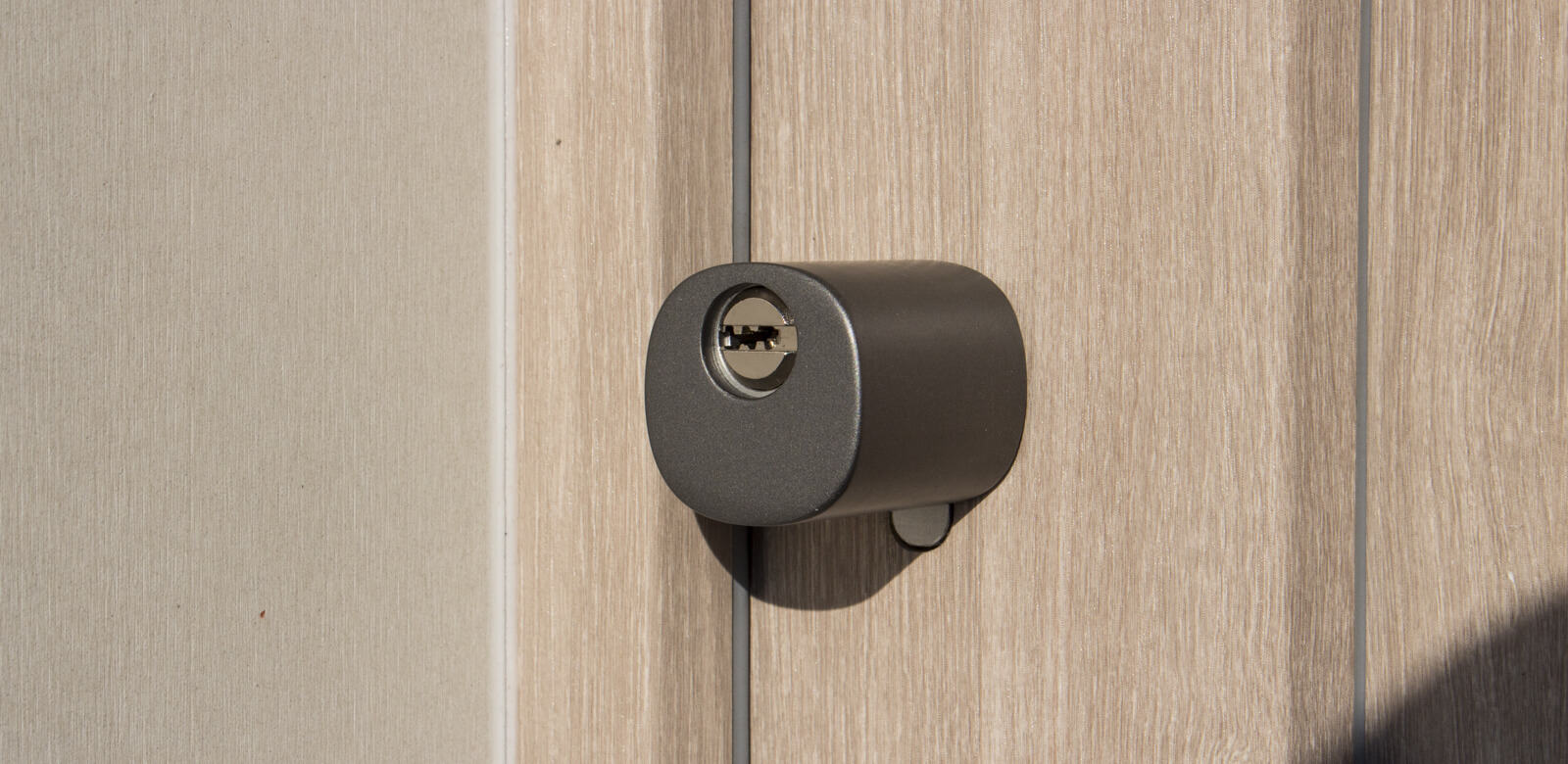
A smart lock with no drilling is the difference between a weekend retrofit and a builder's invoice. For UK renters, landlords, owners of listed buildings and anyone who simply does not want to alter a perfectly good front door, the “no drilling” criterion is the deciding factor between buying a smart lock and walking away from the category entirely. The good news is that the best smart locks of 2026 require zero holes, zero cables, zero changes to the door — they retrofit onto the existing Euro cylinder in about ten minutes with a single screwdriver.
This guide explains exactly what “smart lock no drilling” means in practice, walks through the four-step DORY retrofit on a UK front or composite door, compares the leading no-drilling smart locks side-by-side, and answers the questions that come up most often in 1Control support tickets: tenancy reversibility, mechanical-key fallback, battery life, security defenders.
Skip ahead and see whether DORY fits your door: Discover 1Control DORY or check your door's compatibility in 60 seconds before reading on.
What “smart lock no drilling” actually means
“No drilling” is a benefit description, not a technology. Two completely different smart-lock architectures both meet it, and the difference between them matters more than the marketing pages suggest.
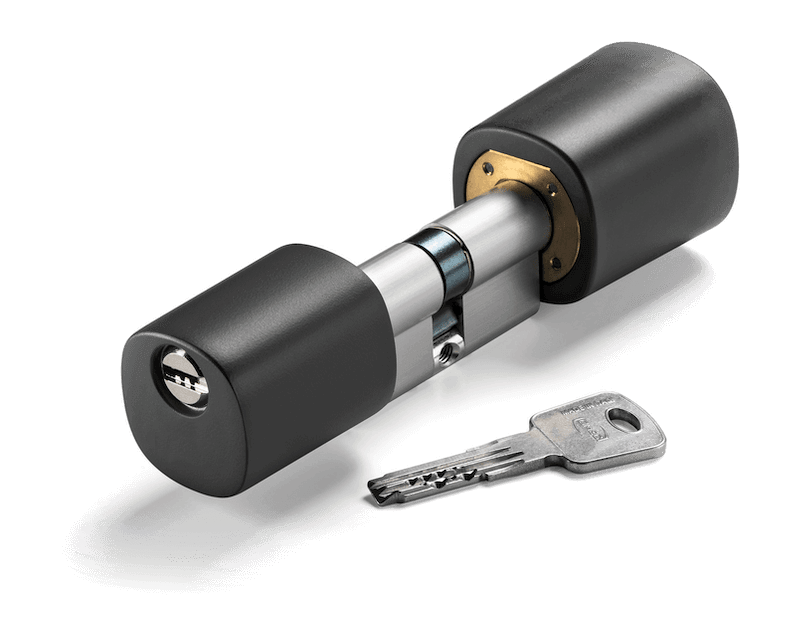
Architecture A — retrofit cylinder swap. The smart lock replaces the existing Euro profile cylinder with an electronic one. The door, frame, handle and strike plate are untouched. The only operation is unscrewing the single lateral screw that holds the cylinder in place, sliding the old cylinder out, sliding the new one in, and re-screwing. 1Control DORY is the canonical example: a one-piece Euro cylinder with the motor and electronics integrated into the thumb-turn end.
Architecture B — motor-on-thumbturn. The smart lock leaves the original cylinder in place and bolts a motorised housing on the inside of the door that grips and rotates the thumb-turn knob on every opening. The housing is held with adhesive plates or a captive strap. Yale Linus L2, Nuki Smart Lock 4 and August Smart Lock Pro 4 all use this architecture. Also “no drilling” technically — but a visible accessory remains on the inside of the door.
Both architectures are reversible in principle. The first leaves the door in factory condition (you put the original cylinder back); the second leaves a clean inside face once you peel off the adhesive. The trade-offs that follow — battery life, mechanical-key behaviour, aesthetic footprint — are explained in the comparison section below.

Explore DORY before checking your door
See how it works, compare DORY MINI, MINI + LINK and DORY, then check in a few steps whether your cylinder and door are compatible.
The 10-minute DORY retrofit, step by step
A no-drilling DORY install is genuinely a single-screwdriver job. The four steps below assume your door already passed the free compatibility tool on the 1Control site, which takes 60 seconds and confirms cylinder length, defender clearance and door thickness before you order.
Step 1 — Measure your Euro cylinder
The included paper measurement tool (a small printed gauge that ships in the DORY box, also downloadable as a PDF) gives you two numbers: the internal protrusion and the external protrusion of the cylinder, measured from the centre of the fixing screw. Write both down. The compatibility tool walked you through this; the in-box gauge confirms it at unboxing.
Step 2 — Unscrew the existing cylinder
One Phillips screw sits on the edge of the door, on the strike side, level with the cylinder. Unscrew it fully. The screw is short (around 60 mm) and never needs replacing. Once it is out, the cylinder slides freely out of the door — rotate the key a quarter-turn if it resists, that releases the cam.
Step 3 — Adjust DORY length with the included extensions
DORY ships with a set of small calibrated extensions that screw onto the body, allowing the cylinder to match your exact door thickness in millimetre steps. No cutting, no sanding, no drilling. Pick the extension combination that matches the two numbers from Step 1, screw them in finger-tight, then check the body alignment is symmetrical inside and outside.
Step 4 — Insert DORY and re-screw
Slide DORY into the cylinder housing from the inside face of the door. Rotate the test key until the cam is horizontal so the cylinder seats fully. Re-insert the original Phillips screw on the edge of the door, snug but not torqued. Test the key on both sides — the door should lock and unlock smoothly. Pair DORY with the 1Control app over Bluetooth from your phone, and the install is done.
| What you need | What you do NOT need |
|---|---|
| One Phillips screwdriver | A drill |
| The paper measurement gauge (in box) | A locksmith |
| Ten minutes | A new door, new frame, new handle, new strike plate |
| The 1Control app on a smartphone | Wi-Fi at install time (Bluetooth pairs locally) |
No drilling vs traditional install: what changes for renters and landlords
Most UK tenancy agreements accept upgrades that are fully reversible and leave no trace. A smart lock with no drilling clears that bar comfortably — particularly the retrofit-cylinder architecture, which leaves the door indistinguishable from the day you moved in.
For renters. The original Euro cylinder takes thirty seconds to reinstall at end of tenancy. You keep the new DORY cylinder for the next property. No drill bits in the door, no adhesive residue on the inside face, no missing parts in the strike plate. Many UK letting agencies have explicitly approved retrofit smart locks on the basis of this reversibility — the conversation is usually about which smart lock rather than whether.
For landlords. A no-drilling smart lock removes the cost and timing risk of changing the lock between tenancies. A revoked tenant share + a fresh PIN for the next arrival replaces a locksmith visit and a stack of new keys. The cylinder stays with the property; only the access list rotates. For UK short-let portfolios in particular, DORY + the optional PAD keypad + the optional LINK hub reduce key-handover friction to zero across the year.

Comparison: which no-drilling smart locks fit a UK Euro cylinder door
The five smart locks below all qualify as “no drilling” on a UK Euro cylinder door. Read across the row for what each one actually means in install effort, battery life and what it leaves behind on the inside of the door.
| Model | Install architecture | Tools needed | Battery life | Mechanical key preserved | What's left on the door |
|---|---|---|---|---|---|
| 1Control DORY | Retrofit cylinder swap | Phillips screwdriver only | ~1 year (2× CR2 lithium) | Yes — 3 (MINI) or 5 (Standard) keys included | Nothing visible — cylinder only |
| Nuki Smart Lock 4 | Motor-on-thumbturn | Allen key + spirit level | ~3 months (4× AA) | Original key retained | Motor housing on inside face (adhesive plate) |
| Yale Linus L2 | Motor-on-thumbturn | Allen key | ~6 months (4× AA) | Original key retained | Motor housing on inside face (adhesive plate) |
| SwitchBot Lock Pro | Motor-on-thumbturn (Euro retrofit kit) | Screwdriver + included adapter | ~6 months (4× AA) | Original key retained | Motor housing on inside face |
| August Smart Lock Pro 4 | Motor-on-thumbturn (US-focused) | Screwdriver | ~3 months (4× CR123) | Original key retained | Motor housing on inside face |
Three observations the comparison page does not explicitly make. First, no-drilling does not mean equivalent: motor-on-thumbturn architectures rotate a key on every cycle, which is why their cells drain in months rather than a year. Second, the retrofit-cylinder approach is the only one that leaves zero visible accessories — if you take the cylinder out, the door is indistinguishable from before. Third, all five preserve some form of mechanical-key fallback, but only DORY ships a fresh set of high-security keys with the lock; the others rely on the existing cylinder, which means the existing keys.
If you are choosing specifically between Nuki and DORY, the detailed head-to-head sits in our Nuki vs DORY comparison. For the bigger strategic question of whether a smart lock fits your household, read the smart-lock buyer's guide.
Common myths about no-drilling smart locks
“No drilling means weaker security.” The DORY cylinder is a high-security OMEC Euro cylinder compliant with EN 1303, the same standard that governs the mechanical cylinder on most UK doors. The keys ship with a copy-protection code printed on a card — you cannot cut a duplicate at a corner shop. The security level is set by the cylinder, not by the drilling.
“No drilling smart locks are temporary.” They are reversible, which is not the same thing. A reversible install is a permanent install that you can undo cleanly if you choose to. DORY can stay on a door for the warranty period and beyond; renters routinely move it from property to property as their default lock.
“Without drilling you lose the keypad option.” The keypad is a separately paired wireless accessory. 1Control PAD mounts outside the door with adhesive or with a single small screw and pairs to DORY over Bluetooth. No drilling required for either device. PAD supports up to 1,000 PINs with time-bound and one-shot codes — the canonical short-let or family-visitor setup.
“A no-drilling lock cannot work with Alexa or remote opening.” It can. The voice and remote layer is added by the LINK Wi-Fi hub, which plugs into a wall socket somewhere in the home and bridges DORY's Bluetooth to your Wi-Fi network. Alexa, Google Home, Siri Shortcuts, Apple CarPlay and Android Auto are all supported. The lock itself stays drilling-free.
When no drilling is NOT enough: edge cases
A small number of doors will not accept any retrofit smart lock without preparatory work — not because of the smart lock itself, but because of the door it sits in. Three cases come up regularly.
Non-Euro cylinder doors. Older UK front doors fitted before the mid-1990s sometimes use a British oval cylinder or a rim lock. Both are non-Euro profiles and will not accept DORY (or any Euro retrofit smart lock) until the housing is converted. A locksmith can replace the lockcase with a Euro-compatible one in around an hour; after that the no-drilling DORY install proceeds normally.
Cylinder defender already fitted. Many UK security doors have an external escutcheon (the defender) that protects against cylinder snapping. Defenders are designed around a few millimetres of cylinder protrusion; an electronic cylinder is slightly longer than a purely mechanical one and may need a different defender size or a different extension on DORY. The compatibility tool walks you through the measurement before you order, including the defender case.
Multi-point locking confusion. Multi-point locks (three to five bolts engaged by lifting the handle) are entirely compatible with no-drilling smart locks — the smart lock controls the cylinder, and the user (or a remote opening) still lifts the handle to engage the bolts before locking. The only nuance is that auto-unlock on a multi-point door only releases the cylinder; the handle still has to be pressed down on entry.
If you have any doubt about your case, the free DORY compatibility check gives you a yes/no answer (and the right cylinder length) before you spend a penny.
Beyond no-drilling: what else makes a smart lock worth installing
Drilling is the first filter; once a lock clears it, the criteria that matter most over five years of daily use are battery life, mechanical-key fallback, and how well the wider ecosystem closes the “what about visitors” question. The keyless entry methods guide goes deeper on the six methods of unlocking a smart lock; the strategic buyer's guide covers when a smart lock is the right choice in the first place. This article stays focused on the install: what “no drilling” means, who it matters to, and how to know your door is ready.
Frequently asked questions
Does a “no drilling” smart lock really require zero modifications to my door?
With DORY: yes. There is no modification to the door, the frame, the handle or the strike plate. The only operation is unscrewing the single lateral Phillips screw that already holds the existing Euro cylinder in place, sliding the old cylinder out and the new one in, and re-screwing the same original screw. When DORY is removed there is no trace on the door.
Can I install a smart lock without drilling on a UK composite door?
Yes, provided the door uses a standard Euro profile cylinder (EN 1303). Most UK composite doors fitted since 2005 do. The free DORY compatibility tool confirms cylinder type and length in 60 seconds before you order.
How long does the no-drilling installation actually take?
About ten minutes for the physical install (four steps: measure, unscrew, adjust length with the included extensions, insert and re-screw) plus another five minutes to pair DORY with the 1Control app over Bluetooth. The only tool needed is a Phillips screwdriver.
Is a smart lock no drilling install reversible for a rental property?
Yes, fully. Reinstalling the original cylinder at the end of tenancy takes about ten minutes and leaves no evidence on the door. Many UK letting agencies and landlord associations explicitly accept retrofit smart locks on this basis — the operation is fully reversible and leaves no holes, no adhesive and no hardware behind.
Smart lock no drilling vs motor-on-thumbturn: which is better?
Different trade-offs. Motor-on-thumbturn locks (Yale Linus, Nuki Smart Lock, August) keep the original cylinder and the original keys, but they drain AA cells in one to six months and leave a visible motor housing on the inside face of the door. Retrofit-cylinder locks like DORY replace the cylinder, last about a year on two CR2 lithium cells, and leave nothing visible — at the cost of swapping the cylinder out. Renters tend to prefer the retrofit-cylinder approach because nothing stays on the door.
What happens to my mechanical key after a no-drilling smart lock install?
On DORY the new cylinder ships with its own set of high-security mechanical keys — three on the MINI version, five on the Standard. Those become your new keys. The old cylinder and the old keys go in a drawer until you ever want to revert the install (end of tenancy, sale of the property, change of mind). Both sides of the door can still be opened with the new mechanical key at any time, even if the batteries are flat.
Do I need professional installation for a no-drilling smart lock?
No. The vast majority of DORY customers install in around ten minutes with a single Phillips screwdriver. 1Control provides step-by-step video guides and a free compatibility tool to confirm fit before purchase. A locksmith is only needed in the edge cases (non-Euro cylinder door, unusual defender geometry, multi-point lockcase that needs converting first).
Can no-drilling smart locks be added to a UK front door with a security defender?
Yes. The defender (the external anti-snap cylinder protector) is designed for a cylinder that protrudes a few millimetres beyond the door face. DORY is slightly longer than a purely mechanical cylinder, but its modular extensions accommodate the difference. The compatibility tool walks you through the defender measurement before you order so that you pick the right extension and avoid a return.