The single most painful task in running a short-term rental is not the cleaning, the laundry, or the listing photos. It is the key handover. You wait around for a 3 p.m. check-in that turns into 7 p.m., you drive across town to drop off a spare set when a guest loses theirs, you change the lock the day a tenant leaves because two of the three keys you handed over never came back. A smart lock for an Airbnb rental property removes the physical key from the booking process entirely — guests unlock the door with their phone, with a one-time PIN, or with both, and the access disappears automatically the moment check-out hits.
This guide is for hosts who run one to a handful of Airbnb-style short-term rentals and want to stop touching keys. It covers the six things to check before buying a smart lock for a rental property — starting with the two most buyers skip: whether the host features need a subscription, and whether the system covers every access point rather than just the apartment door — how 1Control DORY answers them on a standard European front door, how to combine DORY with the PAD PIN keypad and the LINK hub for a complete short-let stack, and what the realistic costs and edge cases look like in 2026.
Want to skip ahead and see if your rental property's door is compatible? Discover 1Control DORY or run the free door compatibility check in 60 seconds before reading on.
Why traditional keys fail short-term rentals
Physical keys were designed for a long-term occupant, not for a rotation of strangers who stay two nights. Every limitation a host complains about is the same property of the metal key, just seen from a different angle.
Keys cannot be revoked. Once a key leaves your hand, you have no way to take it back. A guest who keeps a copy, a courier who hangs on to a spare, a cleaner who lets someone else borrow one — the only response is to swap the cylinder, every time, at the cost of a locksmith call and a few hundred euros. Hosts who run the maths on a busy listing eventually replace the cylinder more often than the bedsheets.
Keys are impossible to schedule. A booking has a start time and an end time. A key does not know that. The only way to enforce check-in / check-out windows with a metal key is to be physically present at both ends, or to rely on a key-safe with a code that you then have to change between guests — which is the same problem rebranded.
Are key lockboxes still allowed? Increasingly, no — at least not on public space. Paris banned key lockboxes from street furniture and public space on 24 January 2025, with fines of up to €1,500 and removal by the city (source: Ville de Paris); Spain's Valencia region has banned them for tourist flats; and Italian cities including Milan, Florence and Rome have followed with local bans and forced removals. If your check-in still hangs on a lockbox, read our guide to the European lockbox bans and the alternatives before your city is next.
Late arrivals cost evenings. The 11 p.m. check-in that turns into a phone call from the kerb is the universal short-let story. A flight is delayed, a train is missed, traffic stops, and the host either drives across town in pyjamas or loses the booking. With keys this is the only failure mode; with a smart lock the guest opens the door themselves whenever they arrive.
Cleaning crews and contractors compound the problem. Anyone who needs occasional access — the Tuesday cleaner, the plumber, the Wi-Fi installer — needs either their own key (a copy you cannot revoke) or a key handover from you (a trip you do not have time for). The smart-lock answer is a time-bound share that expires automatically — we cover the full turnover workflow in our guide to managing cleaner access on an Airbnb.
The 6 things to check before buying
Most consumer smart locks were designed for a homeowner who lives in the house, not for a host who manages bookings. The six checks below are what separates a lock that survives short-term rental use from one that becomes a liability after the third guest — they are the questions hosts report only discovering after the purchase. One thing no lock can do for you, whatever you buy: comply with your local guest-registration and ID rules on its own — several European countries require some form of guest identification or registration, so read our overview of self check-in legal requirements before you design the check-in flow around the hardware.
- Subscription or one-time purchase? The most underrated criterion at checkout and the most resented three years in. Many host-oriented systems tie the features you actually buy them for — automatic guest shares, remote check-in, access logs — to a recurring plan: Nuki's Smart Hosting plan runs around €69 per lock per year, and platforms in the Igloohome mould sell monthly host plans on top of the hardware (figures indicative — always check official pricing). Multiply by doors and by years and the plan outgrows the hardware. The question to ask the vendor is simple: what stops working if I don't renew? 1Control devices are a one-time purchase with no subscription: time-bound shares, PINs, the audit log and remote opening are included, for good.
- Does it cover every access point — or just the apartment door? Cylinder smart locks fit one door. But your guest meets the building entrance, the driveway gate or the garage first, and that is exactly where they get stuck at 11 p.m. A keyless setup that stops at the flat door automates half the problem — the wrong half. Map the whole route from street to bed, then cover each access point: we describe the building-entrance pattern in how to open the building door remotely for guests, and the multi-door setup further down this guide.
- What happens offline — and with a flat battery? The property's Wi-Fi will go down, usually on a Saturday night. Openings have to keep working locally, phone-to-lock, with no internet involved, and there has to be a permanent fallback — a real mechanical key — that survives flat batteries, lost phones and dead routers. Battery life should be measured in months, not weeks: a lock that burns through batteries every two months generates work instead of removing it, and one day a guest arrives to a flat lock.
- Does the guest need an app? Some guests will not install a smart-lock app for a two-night stay, and you cannot force them. The system needs at least one no-app entry method — typically a wall-mounted PIN keypad: the guest types a numeric code, the door opens, no download, no account, no pairing. The PIN can last exactly as long as the booking and disappear afterwards.
- Can you install it with no building work? Anything that needs drilling, wiring or a vote of the building's owners adds cost, delay and permissions you may never get. Prefer the reversible retrofit: a cylinder swap you can undo at end of tenancy, a wireless battery-powered keypad, a hub that plugs into a socket.
- Time-limited shares, remote management and an access log. Every guest access must carry the booking's start and end and revoke itself at check-out — not with a reminder for you to do it manually. The cleaner needs a recurring weekly window, you need to add, revoke and audit everything from your phone wherever you are, and the log must tell you who opened the door and when. This is the difference between a lock “with an app” and a lock built for hosts.
Manage every guest entrance through one access system
Explore the 1Control solution for front doors, shared entrances, gates, guests and staff. Start with the hospitality setup; if you need a smart lock, then check your door for DORY.
1Control DORY for short-term rentals
1Control DORY is an electronic Euro cylinder smart lock built around exactly the trade-off short-let hosts care about: keyless entry as the everyday default, mechanical key as the permanent fallback, no internet required to open the door, and time-bound shares as a first-class feature of the app. DORY is Italian, patented, and designed to retrofit a standard European front door in about ten minutes — a single screw, no drilling, no wiring, no door modification — which makes it acceptable on rented properties and reversible at end of tenancy.
Mapping DORY against the six checks above:
- One-time purchase — DORY, PAD and LINK are bought once, with no subscription: shares, PINs, the audit log and remote opening are included and stay included, however many bookings you run through them.
- Every access point — DORY covers the cylinder door; PAD or SOLO cover electrified gates, garages and building doors, all in the same 1Control app and the same share workflow, so one share routine covers the guest's whole route in.
- Offline operation and flat batteries — openings are local Bluetooth, phone-to-lock, with no internet required; battery life is approximately one year on two CR2 lithium cells (roughly six times longer than the typical motor-on-thumbturn competitor such as Yale Linus, Nuki or August, because DORY drives the cylinder mechanism directly rather than rotating a key); and the mechanical key keeps working in parallel — Standard ships with five traditional keys, MINI with three.
- No-app option — add 1Control PAD, a wireless Bluetooth keypad that sits outside the door. Guests type a PIN, no app required.
- No building work — a ten-minute, single-screw cylinder swap, fully reversible; PAD is wireless and battery-powered; LINK plugs into a power socket. Nothing is drilled, wired or modified.
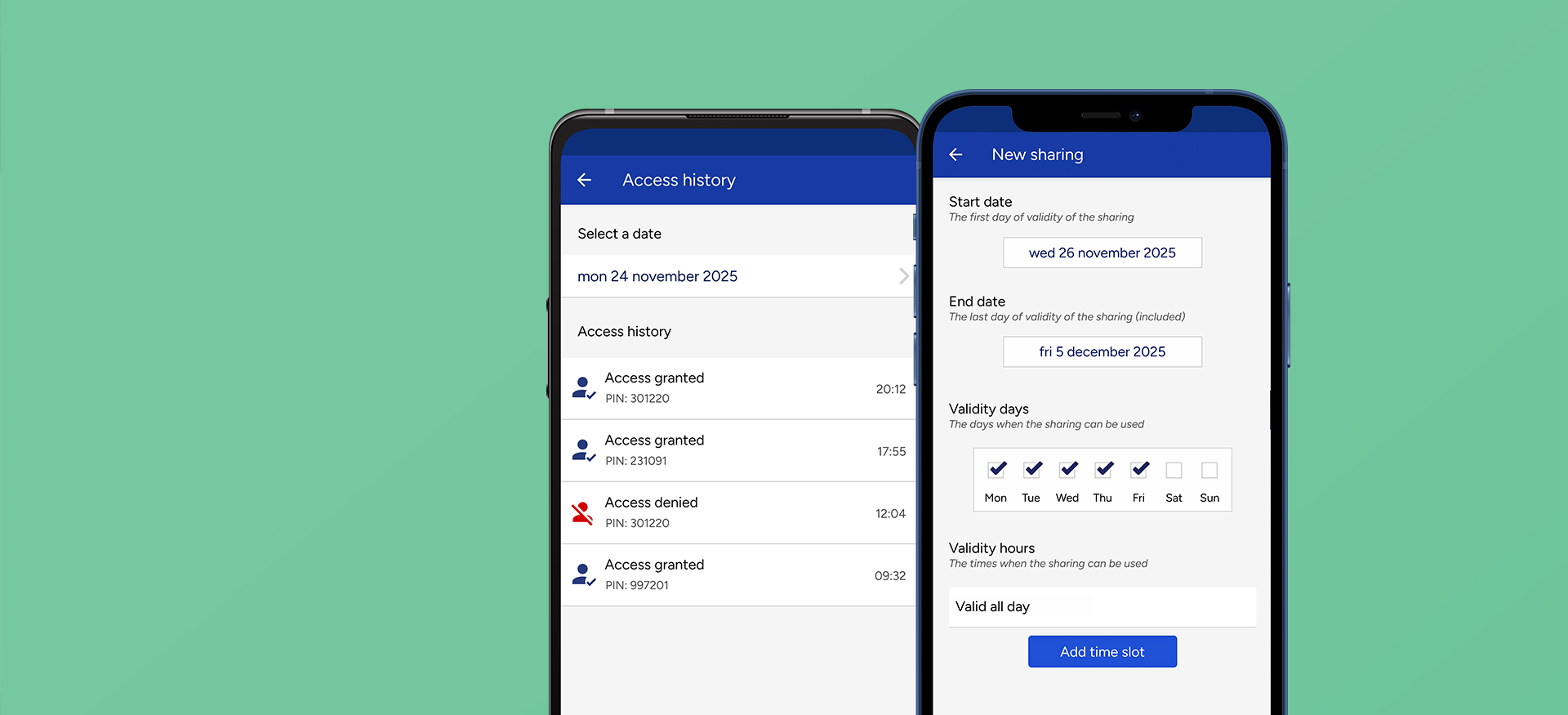
- Time-bound shares, remote management, audit log — built into the 1Control app: each guest share carries start date, end date and optional hour-of-day restrictions, and revokes automatically at end of window; you can add, revoke and audit shares from anywhere, and with the LINK hub you can also open the door remotely.
Time-bound guest access from the 1Control app
The mechanic that does the most work in a short-let setup is the time-bound share. In the 1Control app, the host taps Shares, enters the guest's phone number, selects the DORY device, and sets a start and end window that matches the booking. The guest installs the free 1Control app on their iPhone or Android, registers with the same phone number they gave you (the same number Airbnb already collects), and the access appears in their app automatically — no PDF of instructions, no manual code, no key.
At check-out, the share expires by itself. The host can also revoke it manually at any time — useful if a guest checks out early, if a booking is cancelled, or if anything goes wrong. Shares are free with no monthly or per-guest fee. DORY supports up to 450 users per device across the device's lifetime, which is enough for several years of weekly bookings on a typical listing before you need to clear out old shares.
Mechanical key backup for cleaning crew and emergencies
The mechanical key is the under-appreciated safety net of a short-let smart lock. Hosts typically keep one set with the cleaning crew (so the cleaner can let themselves in regardless of app shares), one set in a small key safe outside the property as a guest-side emergency option in case a phone is lost mid-stay, and a set or two at home as personal backup. Because DORY ships with five mechanical keys on Standard and three on MINI, this is achievable without ordering anything extra. The mechanical path is permanent: it does not depend on batteries, Bluetooth, the 1Control app, the manufacturer's cloud, or your internet connection.
Audit trail: who entered and when
Every opening is logged. The host can see, from the 1Control app, the name of the user who opened the door and the timestamp — for the host, for each guest share, for the cleaner, for anyone with an active share. The audit log is useful for verifying that a guest actually arrived (and on time), that the cleaner came on the promised Tuesday, and for resolving the rare dispute over whether someone was on the property when they claim not to have been. The log is private to the host and not shared with guests.
Setup for hosts: a 4-step workflow
The end-to-end workflow for a host setting up DORY on a rental property is fast and reversible. Most listings are operational within an hour of unboxing.
| Step | What you do | Time |
|---|---|---|
| 1. Check door compatibility | Run the free DORY compatibility tool — an interactive questionnaire plus a printable paper measurer that verifies cylinder length, defender clearance and door thickness. Most European front doors with a Euro cylinder pass. | 5 min |
| 2. Install (retrofit cylinder, no drilling) | Unscrew the single screw holding the existing Euro cylinder in place, slide the old cylinder out, slide DORY in, screw back in. The original cylinder is preserved — keep it for end of tenancy. No drilling, no wiring, no door modification. | 10 min |
| 3. Pair and configure | Open the 1Control app on your phone, pair with DORY using the 8-digit admin code on the inside of the device, set the lock name and admin profile. Optionally add PAD and LINK at this step. | 15 min |
| 4. Issue your first guest share | Shares → New share → enter guest's phone number → set start and end of booking → send. The guest installs the free 1Control app and the access appears automatically. | 2 min per booking |
The reversal at end of tenancy is the mirror image of the install. Unscrew DORY, slide the original cylinder back in, screw in. The door is exactly as it was before. This is what makes DORY landlord-friendly on rented properties: there is nothing to repair, no holes to fill, no paint to touch up — see our dedicated no-drilling install guide for the full step-by-step with photos.
Beyond DORY: PIN access (PAD) and remote unlock (LINK)
DORY is the lock; PAD and LINK are the two accessories that turn it into a complete short-let stack. Neither is required, both pay for themselves quickly on a busy listing.
PAD (PIN keypad outside the door) — the no-app fallback. Some guests refuse to install a smart-lock app for a two-night stay, and pushing them only generates support requests. PAD is a wireless Bluetooth keypad that sits next to the door. The host generates a numeric PIN from the app and binds it to the same start/end window as the booking; the guest types the PIN at arrival, the door opens — the full workflow, from generating codes to communicating them to guests, is in our keypad code entry guide for Airbnb guests. PAD itself supports up to 1,000 PINs, runs on AAA alkaline batteries for two-plus years at ten openings a day, and the PIN can be revoked at any time. The architectural advantage of decoupling the keypad from the lock is durability — the keypad is the exposed component sitting outside in the weather, the lock is dry and safe behind the door, and you can replace one without touching the other.
LINK (hub for remote opening) — the “open from anywhere” capability. LINK is a small hub that plugs into a power socket, joins your 2.4 GHz Wi-Fi (or LAN), and acts as the bridge between the internet and the Bluetooth devices: DORY and PAD stay Bluetooth, LINK relays your remote commands to them. With LINK paired, the host can open the door from the 1Control app on any phone with internet, anywhere in the world. The two short-let scenarios where this earns its keep: a delayed late-night guest arrives, can't get the app working, calls you — you open the door for them remotely; or a contractor or cleaner arrives early when nobody is on site — same. LINK also enables Alexa, Google Home, Siri Shortcuts, Apple CarPlay and Android Auto integrations for the host, though those are less relevant on a rental property than on a primary residence.
The complete short-let stack is therefore DORY + PAD + LINK: the lock handles everyday phone openings and the mechanical key fallback, PAD handles the no-app guests, and LINK handles remote unlocks. Hosts running a single property frequently start with DORY only, add PAD after the first stubborn guest, and add LINK after the first 11 p.m. phone call. The stack pays itself back in saved trips and saved cylinder swaps within the first few months on a busy listing.
DORY vs Yale Linus vs Nuki for Airbnb hosts
The three locks most short-let hosts shortlist in the UK and EU are 1Control DORY, Yale Linus L2 and Nuki Smart Lock 4. They make different architectural choices that matter more on a rental than on a primary residence.
| Feature | 1Control DORY | Yale Linus L2 | Nuki Smart Lock 4 |
|---|---|---|---|
| Time-bound guest shares | Yes, free, in app | Yes (Yale Access) | Yes (Nuki app) |
| Max users per device | Up to 450 | Up to 100 | Up to 200 |
| Subscription for host features | None — one-time purchase, everything included | None for basic features | Basic features free; Smart Hosting plan ~€69/lock/year (indicative, check official pricing) |
| Battery life (real-world) | ~1 year (CR2 lithium x 2) | ~2 months (AA x 4) | ~2–3 months (rechargeable) |
| Mechanical key fallback | Always (3 or 5 keys included) | Original key retained | Original key retained |
| Internet required to open | No (BLE local) | No (BLE local) | No (BLE local) |
| PIN keypad accessory | 1Control PAD | Yale Smart Keypad | Nuki Keypad 2.0 |
| Remote opening | Via 1Control LINK | Via Yale Connect | Via Nuki Bridge / Matter |
The three numbers a host should focus on are the recurring cost, users per device and battery life, all of which compound with bookings. A per-lock yearly plan multiplies by every door and every listing you add — on a three-door property, three years of a ~€69/lock/year plan comfortably exceeds the price of the hardware itself, which is why check number one of the buying list above comes first. A motor-on-thumbturn lock that runs through batteries every two months will need a battery change roughly every six guests on a weekly-turnover listing; DORY's one-year battery drops that to twice a year. The user-cap matters less in absolute terms but is a quiet ceiling on how many guests the device can host across its lifetime before old shares have to be cleaned out. For a deeper architectural comparison see our dedicated Nuki vs DORY guide; for the UK Euro-cylinder shopping question see our keyless entry guide.
Edge cases short-let hosts should plan for
Security doors with a defender. Many higher-end European front doors carry an external defender (an escutcheon designed to protect the cylinder against snapping). DORY is compatible with most defenders, but cylinder protrusion needs checking before purchase — an electronic cylinder is slightly longer than a purely mechanical one and may need a different defender size. See the smart lock for security doors guide for the measurement details.
Guests without smartphones. Rare but not unheard of, especially with older guests. PAD with a PIN solves this completely — no app, no phone, just a number.
Properties with multiple doors. A common setup is a building entrance plus the flat's front door. DORY handles the flat door; for the building entrance, if it has a remote-controlled gate or buzzer, 1Control SOLO can copy that remote into the same app so a single guest share covers both doors, and PAD can put a PIN on any electrified entrance. See the smartphone gate opening guide for the gate pattern, and how to open the building door remotely for guests for the shared-entrance and intercom case.
Network outages. Local Bluetooth openings (phone, watch, PAD) keep working with the router unplugged. Only remote opening via LINK requires the internet at both ends.
Frequently asked questions
Which is the best smart lock for Airbnb without a subscription?
The one that covers your actual access points without tying the host features to a paid plan. When comparing, always ask what stops working if you don't renew: in several host-oriented systems (Nuki's Smart Hosting plan, self check-in platforms) automatic guest shares, remote check-in and access logs are part of the subscription. In the 1Control ecosystem, DORY (the door), PAD (electrified entrances) and LINK (remote opening) include every host feature with the one-time purchase — nothing expires, nothing downgrades.
Is a smart lock allowed on an Airbnb rental property?
Yes. If you own the property you are free to install a retrofit smart lock such as 1Control DORY, which swaps the Euro cylinder in about ten minutes and leaves no holes or wiring on the door. If you rent the property and host on Airbnb yourself, check the tenancy agreement first — most UK landlords accept a fully reversible Euro cylinder swap once it is clear that the original cylinder can be reinstalled at end of tenancy with no trace on the door.
How do I send a smart lock access to my Airbnb guest?
With DORY you share an access by phone number from the free 1Control app. You set a start date and time (check-in) and an end date and time (check-out), optionally restricted to specific hours. The guest installs the free 1Control app on their iPhone or Android, registers with the same phone number, and the access appears automatically — no PDF instructions to send, no physical key to hand over. If the guest does not want to install an app, add 1Control PAD outside the door and issue a numeric PIN with the same time bounds.
What happens if the smart lock battery dies during a guest stay?
DORY keeps working with a traditional mechanical key, in parallel, by design. The Standard ships with five keys and the MINI with three — most hosts keep one with the cleaning crew and store another in a small key safe outside the property as a guest-side emergency option. No guest is ever locked out because the cylinder is a real cylinder, not a digital-only one. Battery life on DORY is approximately one year, much longer than the typical two months of motor-on-thumbturn competitors, so this scenario is rare in practice.
Can I unlock the door for a guest remotely from another city?
Yes, with the optional 1Control LINK Wi-Fi hub. LINK is a small Wi-Fi 2.4 GHz hub that bridges DORY's Bluetooth signal to the internet. Once paired, you can open the door from the 1Control app on any phone with internet — useful for delayed late-night arrivals, contractors, cleaners running late, or simply to verify that the lock locked behind a guest. Without LINK, DORY still opens locally from the guest's phone, watch and from a paired PAD keypad.
How many guests can I host with one DORY?
Up to 450 users per DORY device. The Standard version starts with 10 users included and the MINI with 3; more can be added with a one-off in-app top-up — still a one-time purchase, with no monthly per-guest or per-share fee and no subscription. Sharing itself is always free. For a typical short-term rental that turns over weekly, the included user count is enough for around a year of bookings; high-turnover hosts can top up users from the app in seconds.
Is DORY compatible with my rental property's door?
Most European front doors and composite doors built since the mid-2000s use a standard Euro profile cylinder (EN 1303) — these are compatible. Use the free compatibility tool at 1control.eu/dory_compatibility before buying: it walks you through a short questionnaire and lets you print a paper measuring tool to verify cylinder length, defender clearance and door thickness. If your door already has a Euro cylinder, the answer is almost always yes and the install takes about ten minutes with a single screw.