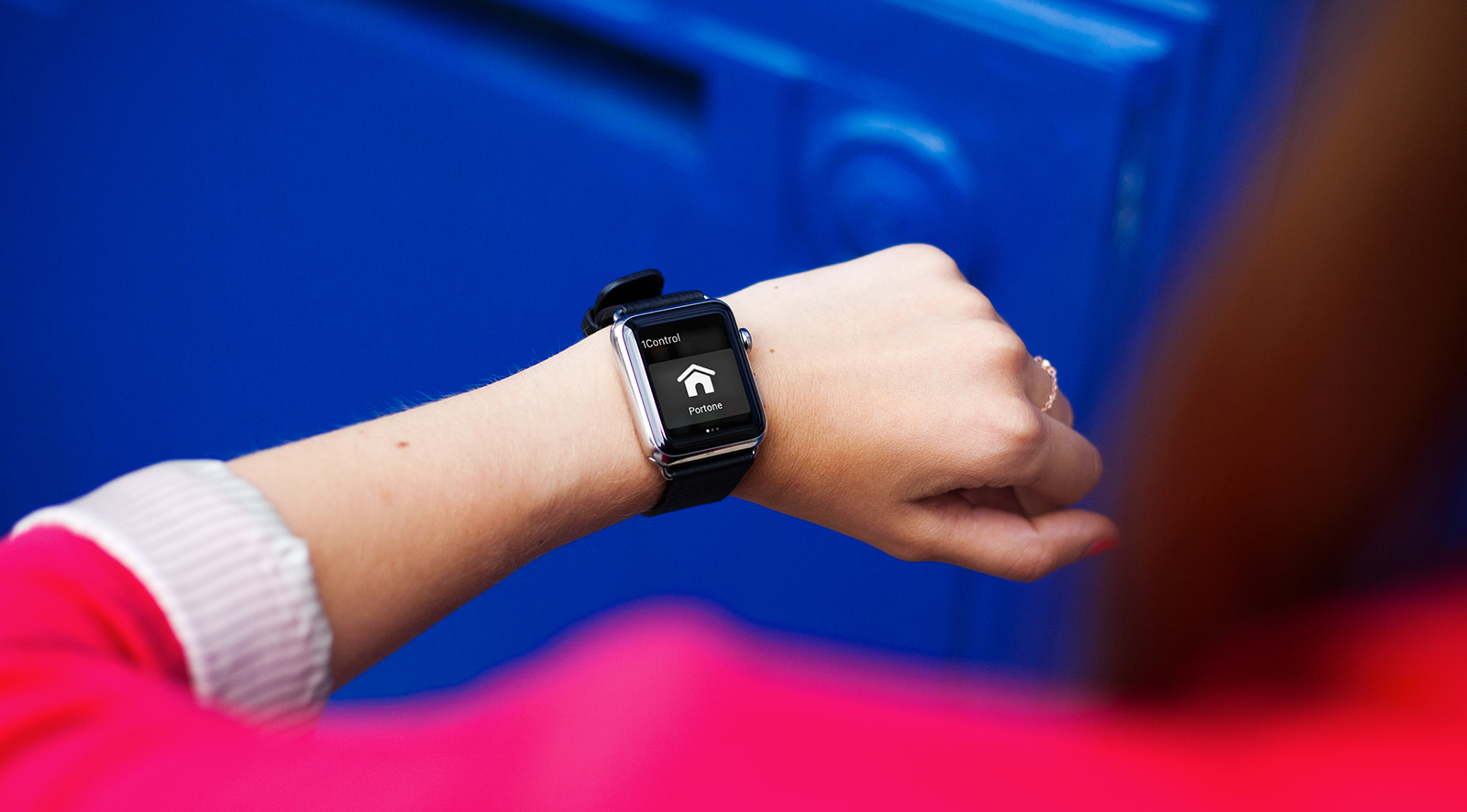
A smart lock is no longer the trade-show curiosity it was five years ago: it has become a serious purchase for anyone hosting guests, managing short lets, dealing with cleaners, carers and deliveries — or simply for anyone tired of the bunch of keys that multiplies with every new family member. Searches for "smart lock" and "keyless entry" have doubled in the UK and across English-speaking Europe in the last three years, but the market noise is huge: white-label products that last two months, motorised models that drain batteries in three weeks, cloud apps that disappear when the manufacturer shuts up shop.
This is not a technical how-to — protocols, hub topology and installation steps belong to a separate product manual. This is a strategic buyer's guide: it helps you decide whether you actually need a smart lock, which ecosystem to build around it, the real risks involved, and what the device actually costs — not just on day one, but over the next five years. The worked examples lean on 1Control DORY, the Italian smart lock designed in partnership with OMEC and installable as a Euro cylinder swap in about ten minutes.
Want to know straight away whether it fits your door? Discover 1Control DORY or check your door's compatibility in 60 seconds before reading on.
Why the smart-lock market is exploding now (and not ten years ago)
The smart lock is not a "tech novelty" parachuted onto the market: it is the convergence of three technology curves that finally met in the last five years. The first is the maturity of Bluetooth Low Energy: a BLE chip draws so little current that a battery-powered BT LE device can now run for a year on two coin or lithium cells. Ten years ago a connected lock would have required mains wiring or monthly battery swaps — an immediate barrier for the consumer market.
The second is the spread of compact, long-life lithium batteries — CR2 and CR123 formats — that made it possible to power an electronic cylinder for over a year with no external power. The third is the smartphone becoming a universal authentication token: the same device that opens your bank app, your electric scooter and now your front door. Without these three things together, a smart lock would still be a showroom gadget.
To this add a very concrete shift in daily habits post-2020: daily deliveries, hybrid work that fills and empties homes unpredictably, and short-term rental platforms that have become economic infrastructure. The traditional key, designed for households with fixed schedules and stable occupants, is poorly suited to those new dynamics. Smart locks fill exactly that gap.
Smart lock vs electronic lock vs keyless entry: the words the market keeps confusing
Google searches mix a dozen overlapping terms that often point at the same object. Smart lock, electronic door lock, keyless entry lock, smart door lock, Wi-Fi lock, Bluetooth lock: in the vast majority of cases they describe the same thing — a cylinder, or a device that controls one, that you can operate from a smartphone over Bluetooth, Wi-Fi or via a hub. The lexical differences say more about the searcher than about the product.
"Electronic door lock" is the older term: it also covers safe locks and B&B keypad systems. "Smart lock" is the modern term, and implies integration with a smartphone app, virtual keys and access logs. "Keyless entry" — the dominant US-English phrase that has now crossed into UK SEO — describes the user-facing benefit rather than the device: opening your door without inserting a metal key, either via your phone, your smartwatch, a keypad PIN or a proximity tag. Biometric locks are a sub-category: they use a fingerprint reader or face recognition either instead of, or alongside, the app. Motorised locks are a specific architecture: they bolt an external motor onto your existing thumb-turn and physically rotate the key from inside.
The label you type into Google matters less than the architecture sitting underneath. A Euro cylinder retrofit smart lock with BLE and a mechanical backup key like DORY is a fundamentally different product from a motor-on-the-key smart lock that drives your existing thumb-turn from the inside. Same words, very different daily experience — different battery life, different noise profile, different fallback story.

Explore DORY before checking your door
See how it works, compare DORY MINI, MINI + LINK and DORY, then check in a few steps whether your cylinder and door are compatible.
Black Friday smart locks: 8 checks before you buy
A discount cannot fix an incompatible door. Before buying a smart lock during Black Week, check these eight points across the door and the complete setup.
- Installation type: Establish whether the product replaces the Euro cylinder or turns an existing internal key or thumb-turn.
- Cylinder and measurements: Confirm the Euro profile, measure both sides from the fixing-screw centre, and inspect clearance, hardware and door movement.
- Mechanical fallback: Identify the key or documented route that remains available when the phone, electronics or battery cannot be used.
- Battery: Check its type, stated life, low-power warnings and the documented behaviour as power runs out.
- Nearby and remote use: Separate Bluetooth operation at the door from internet-based functions, adding a hub only for a real remote requirement.
- Family and guests: Look for named, revocable and time-limited credentials; an administrative code is not automatically a user PIN.
- Contents and costs: Compare included accessories, required extras, batteries, services and any genuinely applicable recurring charge.
- Price, warranty and returns: Compare the real prior price and read the sale period, served countries, warranty and return route.
The three buyer profiles who actually purchase a smart lock
Most industry articles compare locks feature by feature — remote opening, guest codes, access history. The right way to choose a smart lock is not from the feature list: it is from the use profile. Across years of 1Control support tickets, three profiles cover 90% of purchases.
Profile 1 — Family with rotating access. Couple with teenage children who lose keys, recurring cleaner or carer, weekly help, relatives who pop in to feed the cat. The real problem is not "opening from outside": it is "stopping the spiral of cutting more keys and never knowing who has been in". Solution: DORY Standard (10 app users out of the box, 5 mechanical keys). What matters here is a unified access log (who opened the door and when) and time-bound shares. Check compatibility with your door before choosing the model.
Profile 2 — Short-let host (Airbnb, Booking.com, Vrbo, holiday cottages). Weekly turnover, guests arriving at unpredictable times, impossible to be there for every check-in. The real problem is "stop managing physical key handovers". Solution: DORY Standard + LINK hub to generate time-bound PIN codes and access links from the app, receive opening notifications, and integrate with your booking calendar. The payback arrives within a handful of bookings.
Profile 3 — Small business or professional practice. A clinic, a solicitor's office, a coworking space, a small office with staff coming and going. The real problem is "stop cutting new keys every time someone leaves the team". Solution: DORY Standard scaling up to 450 users, instantly revocable shares, an access log the office manager can pull at any time. No more lost keys forcing you to swap the whole cylinder.
It is an ecosystem, not a single product: how to think about a connected home
One of the most frequent mistakes is to evaluate a smart lock as a standalone product. The real value emerges when it sits inside a coherent ecosystem. The front door is not the only access point worth making intelligent: there is the driveway gate, the garden side door, the garage, the bike-shed padlock, the storage cage. If each of those is solved by a different app from a different vendor, you end up with five accounts, three apps and four sets of credentials to maintain.
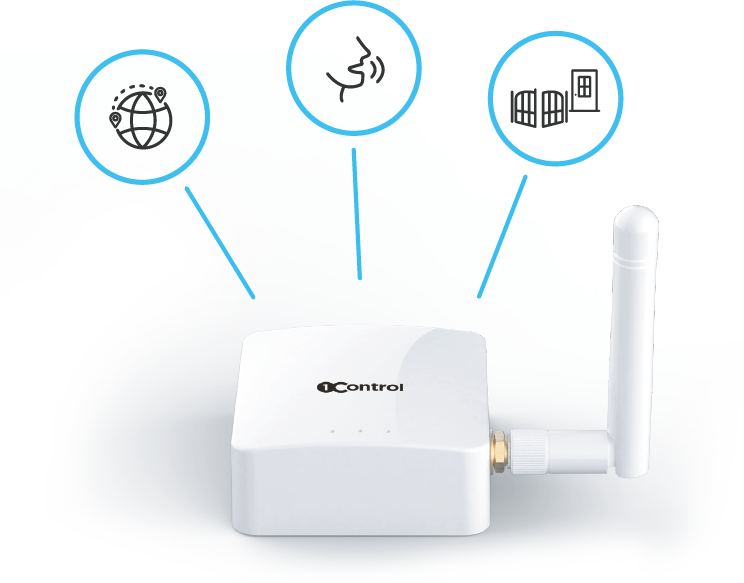
The 1Control ecosystem is designed to live under one app, one account, one unified access log. DORY handles the front door, SOLO opens the driveway gate by replicating the existing remote signal, PAD adds a keypad for guests and short lets, and LINK is the hub that bridges everything to the home network and unlocks the remote features. A single time-bound share can open both the gate and the front door for the courier within the same window.
The organisational payoff is visible on the very first real case. The Thursday cleaner receives access valid only from 8 to 11 on Thursdays, and that access opens gate and front door at the same time. The owner sees, in the app, the sequence: gate at 8:02, door at 8:04, door out at 10:47, gate at 10:48. No phone calls, no keys, no "I left the spare in the planter". Buying the lock without thinking about the gate or the keypad means buying half a solution and discovering the other half six months later.
The real total cost of ownership over five years (beyond the sticker price)
The list price is the obvious psychological barrier, but it is the least interesting line when you do the honest sum. The TCO — total cost of ownership across the five-year expected service life — tells a different story. You have to add up: initial price, batteries replaced every year, any extra mechanical keys for new users, a Wi-Fi hub if you want remote opening, and the cost of doing nothing — emergency locksmiths for lost keys, cylinder swaps after staff changes, time spent on physical key handovers.
| Cost item (5 years) | DORY MINI + LINK | Motorised smart lock (e.g. Nuki, Yale Linus L2) | Traditional lock |
|---|---|---|---|
| Initial price | One-off purchase (lock + hub) | ~£280 / €330 (lock + bridge) | ~£70-130 / €80-150 (cylinder + 5 keys) |
| Batteries over 5 years | ~£20 / €25 (CR2 lithium, 1/year) | ~£70-100 / €80-120 (AA, 4-6 sets/year) | £0 |
| Extra keys / cylinders | £0 (unlimited app users) | £0 (unlimited app users) | ~£45-90 / €50-100 (new copies) |
| Lockout / emergency locksmith | £0 (mechanical key always works) | ~£130 / €150 average (1 lockout) | ~£130 / €150 average (1 lost key) |
| Total over 5 years | Purchase price + ~£20 / €25 batteries | ~£480-510 / €560-600 | ~£245-350 / €280-400 |
The numbers are indicative and vary with household, usage intensity and city. The structural message holds: a well-designed smart lock costs, over five years, less than a traditional lock plus a single lost-key incident, and clearly less than a motorised competitor, because the battery line and the lockout line weigh more than they appear at first glance. Subscription-only cloud features from some US-centric brands push the gap wider still.
Battery life — the metric that separates serious products from gadgets
If you were going to look at one single spec to judge how seriously a smart lock has been engineered, look at battery life. This is not marketing fluff: it is a direct proxy for the product's architecture. A lock that lasts a month has, almost certainly, an external motor turning the physical key — an operation that draws significant current on every opening. A lock that lasts a year has a different design: the motor acts directly on the cylinder mechanism, in milliseconds, with an order-of-magnitude lower energy budget.
This is the structural reason why DORY achieves about one year on two CR2 lithium batteries, while motor-on-the-key competitors typically sit at 1–3 months on a set of AA cells or a rechargeable internal pack. A factor of 4× to 10×. Translated into everyday life: a DORY owner remembers about batteries once a year, while a motorised-lock owner has to schedule them seasonally or live with recurring "low battery" notifications. SwitchBot Lock Pro improves on this with an external bridge, but still trails a native Euro cylinder design on duty cycle.
There is a second-order effect that is easy to miss. A lock that goes silent every few months trains you to treat low-battery warnings as background noise; eventually you ignore one and find yourself with a dead lock in the rain. A lock with a year of runtime is reliable enough to disappear from your attention, which is exactly the goal of a piece of home infrastructure.
The risk matrix: what can actually go wrong (and what cannot)
"Is a connected lock actually safe?" is a fair question every buyer asks, and the honest answer is structured rather than reassuring. Security is not a single attribute: it is a matrix of risk scenarios, each with its own probability, impact and mitigation. Below are the five scenarios any smart lock should be evaluated against, with DORY's specific mitigations.
| Risk scenario | Probability | Impact | DORY mitigation |
|---|---|---|---|
| Physical attack on the cylinder | Medium | High | High-security OMEC Euro cylinder with double-row pins, compatible with standard escutcheons and defenders |
| Unauthorised key duplication | Low | High | Keys can only be copied by presenting the secret code printed on a card supplied in the box |
| Admin PIN compromise | Very low | High | 8-digit admin PIN distinct from the door-opening flow, changeable from the app |
| Sudden flat battery | Low (with progressive warnings) | Low | Mechanical key always active: no lockout possible |
| Cloud or internet outage | Medium | Low | Local Bluetooth LE opening does not route through the cloud: it keeps working with the router unplugged |
The structural point: most of the "digital" risks that worry new buyers — hacking, the cloud going dark, the app no longer receiving updates — have low impact when the architecture has been designed with a mechanical fallback as the default. A key that works regardless of battery, server and network is the single feature that changes the product's risk profile. It also explains why Yale, August and other cloud-first US designs require more elaborate backup options (battery jumpers, third-party Wi-Fi resets) than a Euro cylinder retrofit needs.
The Euro cylinder standard — and why it quietly decides which locks fit your door
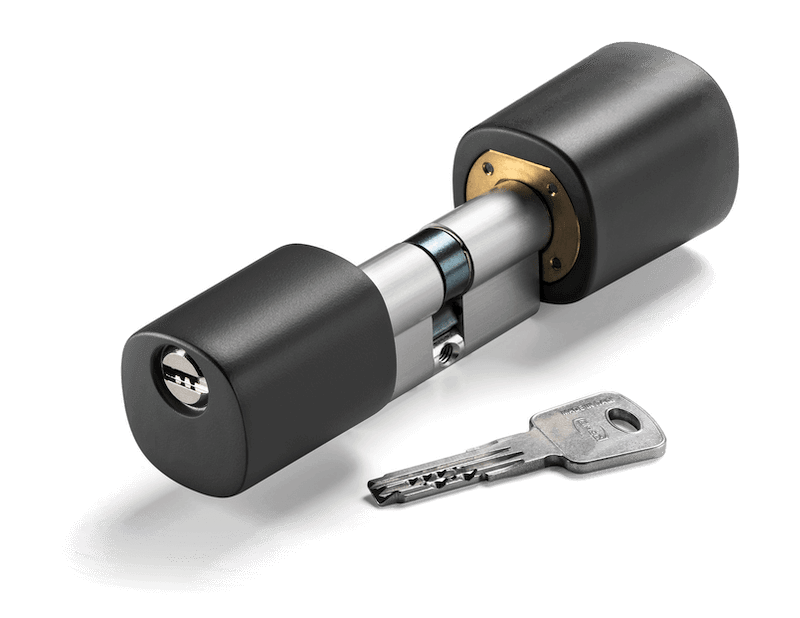
When people in the UK and continental Europe talk about a lock cylinder, they are almost always talking about the Euro profile cylinder, codified by the EN 1303 standard. It is the shape that has been universal across the EU and UK for decades, recognisable by its "double profile" silhouette on either face of the door. This standardisation, which sounds like trivia, is the single biggest reason why retrofit smart locks work in Europe.
Adopting one common shape means the spare-parts market, the locksmith ecosystem and compatibility coverage are enormous and mature. If your cylinder fails, any locksmith will swap it in half a day. If you change smart lock five years from now, the next one will speak the same "mechanical language". There is no geographic or vendor lock-in: the door is still a door, and any standard cylinder can be installed. This also holds in the worst-case scenario where a brand disappears — you simply refit a traditional cylinder and you are back where you started, without scars on the door.
The rare incompatibilities involve older locks with double-bit keys (the long stick-shaped keys still found on some older Italian and Spanish doors) or pre-installed electromechanical systems. In those cases the first step is to replace the existing block with a standard Euro cylinder, a routine job for a qualified locksmith. Once that is done you are ready for any quality Euro cylinder retrofit (our guide on how to change a door lock covers the mechanical job itself, from identifying the lock type to measuring and swapping the cylinder). American-format deadbolts (common in the US and Canada) are a different mechanism altogether — Yale and August focus on that market, while DORY, Nuki and Tedee live in the Euro-cylinder world.
Smart locks on UK security doors and composite doors
If you have a UK composite door, a multi-point locking system or an EU-style security door ("porta blindata" in Italian, RC3-rated reinforced doors), the question is not just "is it compatible?" — it is strategic. A composite or security door is probably the single most expensive item you have bought for home security — £900 to £2,500 in many cases — and pairing it with a smart lock deserves more thought than a simple internal door swap.
Some strategic questions to ask before you buy. Is the security door more than 15 years old? In that case the original cylinder may be obsolete and the opportunity to add a smart lock also coincides with a necessary security upgrade. Are you renting? The reversible retrofit nature of DORY — cylinder swap, no drilling — lets you reinstall the original cylinder at end of tenancy with no damage to the door, which protects your deposit. Are you in a listed building or conservation area? A retrofit smart lock does not alter the external appearance of the door, an important point in restricted contexts where bolt-on motorised units would be refused planning.
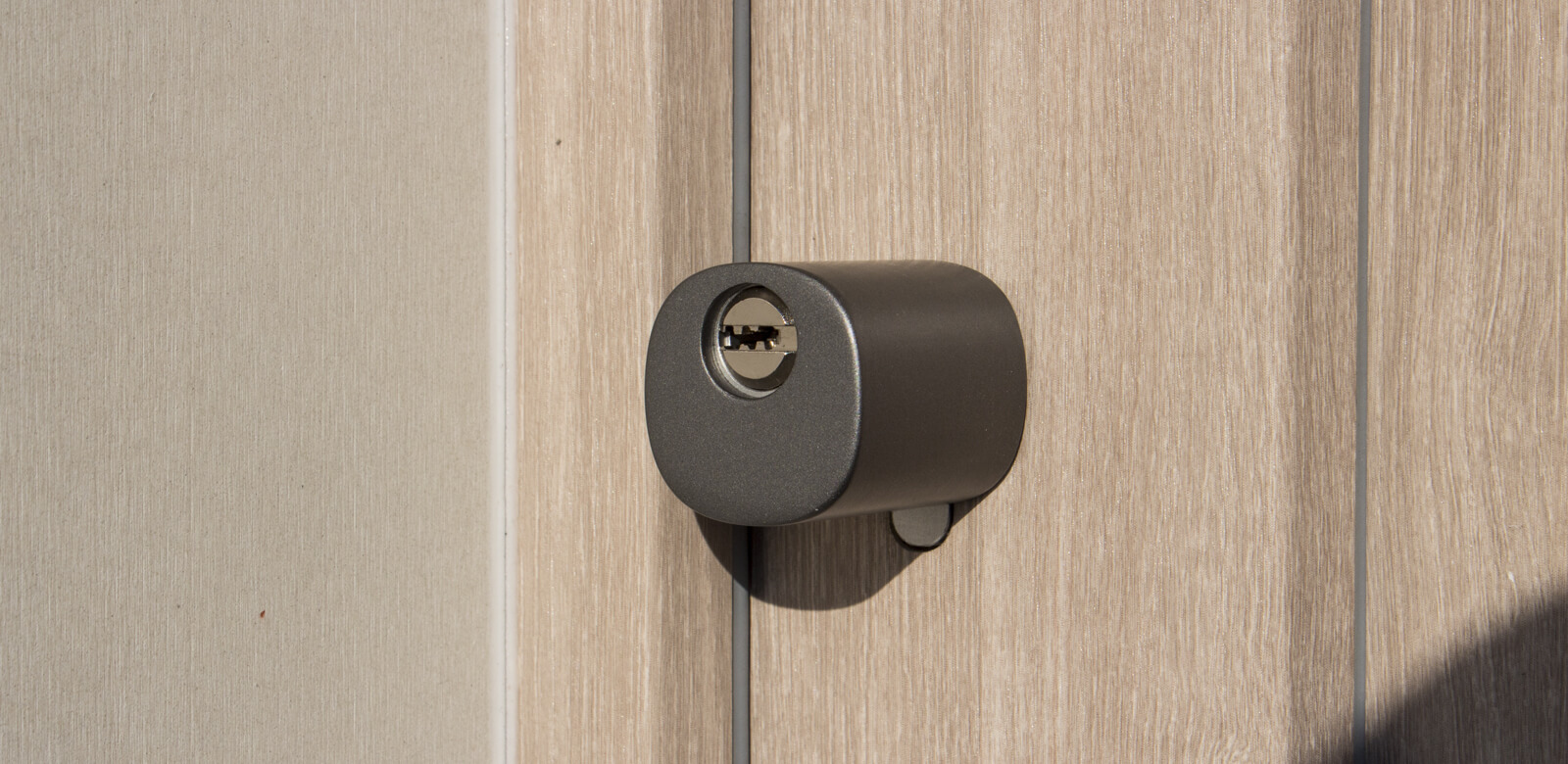
The thing that most often makes buyers hesitate is the defender — the external escutcheon plate that protects the cylinder against snapping and pulling. The good news: modern composite and security doors almost always carry standard Euro cylinders and defenders that are compatible with DORY. The mechanical security of your door is not compromised, because the DORY cylinder is itself a high-security cylinder built to a security grade consistent with what reinforced doors expect. The important nuance — and the difference vs DIY motorised locks bolted on the inside — is that the external profile of the door stays clean and the snap-resistance of the cylinder is preserved.
Made in Italy and the OMEC partnership — why the supply chain matters on a security product
A smart lock is not a thermostat: it is the device deciding who walks into your home. For that reason the manufacturer's supply chain matters more than buyers usually expect. DORY is designed and manufactured in Italy in partnership with OMEC, an Italian lock specialist with over 65 years of experience. The mechanical part of the cylinder comes from OMEC's long track record on residential and security-door locks; the electronics are engineered by 1Control, an Italian innovative SME with European patents.
What this changes in practice. Spare-parts availability: extra keys, extensions for unusual door thicknesses and replacement batteries are easy to source across Europe and the UK. Support in English: technical support handled directly by the manufacturer, warranty processed in-house, no offshore call centres. Product continuity over time: regular firmware updates, an actively maintained app, no "vanishing brand" risk that occasionally affects white-label products imported via marketplaces.

When NOT to buy a smart lock
Commercial honesty starts by saying when a product is not the right answer. A smart lock is not the right tool in every scenario, and there are specific cases in which it is better to wait or simply not invest.
- You rent under a tenancy that explicitly forbids modifications. Even though DORY is a reversible retrofit, a strict tenancy may treat a cylinder swap as a modification. Check with your landlord or letting agent first; most are happy once they understand the original cylinder will be reinstalled at end of tenancy.
- You actively dislike anything "smart" and only want a mechanical key. If app-based features, time-bound shares and an access log do not interest you at all, a good traditional key still does its job. DORY can still make sense even when you live alone — opening without fishing for keys, one-off sharing with a locksmith or neighbour, a notification if someone comes in — but if the intent is truly "no smart features for me", wait until there is a real need.
- Your existing door has known structural problems. If the door does not shut properly, has excessive play or is out of square, the first investment is a joiner or locksmith to fix the door. A smart lock only adds value on a door that already closes cleanly.
- Budget under £150 / €170. At that price point smart locks come with serious compromises on battery, cylinder quality and long-term support. Better to wait six months and buy a serious product than to settle for a compromise that frustrates you on day 30.
- Bluetooth coverage is poor at the install location. Cellar doors deep behind metal stairwells, or doors set inside heavy steel frames, can attenuate the BT signal enough to be inconvenient. Worth a quick on-site sanity check before ordering.
If the smart-lock case is there, but you are also wondering about gate access, voice control and broader scenes, the right starting question is not "which lock" — it is "which ecosystem". Locks, gates and remotes that live under one app are the fastest route to a connected home that actually feels coherent in daily use.
Buyer's roadmap — from curiosity to your first remote unlock
Once you have decided on the direction, a smart lock follows a clear sequence of steps. Nothing complicated, but it is worth knowing the order so you can set expectations correctly on timing.
- Check compatibility (10 minutes). Open the DORY compatibility tool from the 1Control website. Measure the existing cylinder — the tool tells you exactly what to measure and where. The output is the correct combination of extensions for your door thickness. If your door is an unusual security door, also download the language-specific compatibility PDF.
- Pick the right model (30 minutes). Based on the use profile (see the three buyer profiles above), choose between DORY MINI (2 app users, 3 keys), DORY MINI + LINK (2 users plus remote opening), and DORY Standard (10 users expandable to 450, 5 keys). If remote opening and voice commands matter to you, include LINK from the start — adding it later is easy, but bundling is cheaper.
- Order and delivery (2-3 business days). Shipping across the EU and the UK is fast. The box contains everything: the lock, extensions for standard door thicknesses, mechanical keys, batteries, a card carrying the secret duplication code, mounting hardware and a cardboard gauge for measuring your door.
- Install and onboard (15-20 minutes). One Allen key, the free 1Control app on your phone, ten minutes to remove the old cylinder, ten to install the new one, five to pair and configure users. Installing LINK adds five minutes if there is a free power socket near your router. From that moment the door is openable from the app. 30-day returns if it does not match expectations.
DORY in summary — what to take home from this guide
A serious smart lock today is a predictable, mature investment, not an experiment. The difference between a serious product and a gadget shows up on four measurable metrics: battery life (one year, or three months?), mechanical fallback (does the key always work, or is there a lockout risk?), supply chain (Italian, with 65+ years of OMEC behind the cylinder, or generic white label?), and ecosystem (one app for every access point, or five different apps?).
1Control DORY answers yes on all four: one-year runtime on CR2 lithium cells, a permanent mechanical key as backup, designed and built in Italy with OMEC, and an integrated ecosystem with SOLO, PAD and LINK in a single app. The concrete starting point is the compatibility check for your door — 60 seconds, free, and it tells you exactly which extension combination you need. If the check passes, installation is a Saturday afternoon job and the 30-day return policy keeps the risk contained.
Frequently asked questions
What does keyless entry actually mean on a smart lock?
Keyless entry is the ability to open your door without inserting and turning a traditional metal key. With a smart lock like 1Control DORY you unlock from the app on your phone or smartwatch over Bluetooth Low Energy, or from a paired keypad such as the 1Control PAD. The mechanical key still exists in your pocket as a permanent backup, so you are never locked out if the batteries die or the phone is missing.
Can I install a smart lock in a rental property without permanent modifications?
Yes, if it is a Euro cylinder retrofit smart lock like 1Control DORY. You only swap the existing cylinder, in about 10 minutes, with no drilling, no wiring and no changes to the door, frame or handle. When you move out you reinstall the original cylinder: the operation is fully reversible and leaves no trace on the door.
How long do smart lock batteries actually last in daily use?
It depends on the architecture. Motor-on-the-key smart locks (Yale Linus, Nuki, August) typically last 1 to 3 months because the motor physically turns the key on every opening. Euro cylinder retrofit smart locks with Bluetooth Low Energy, like DORY, last about one year on two CR2 lithium batteries in normal household use. The real metric is not battery capacity but how much current the product architecture consumes per cycle.
Does a smart lock still work if the internet or Wi-Fi goes down?
Yes, if the lock talks Bluetooth Low Energy directly to your phone in proximity, as DORY does. Local opening does not route through the internet and works with the router unplugged. You only lose remote features (opening from outside the home, voice commands via the LINK hub, push notifications), which come back automatically when the network is back.
Does the physical key still work once a smart lock is installed?
On DORY, always. The cylinder keeps the mechanical key as a permanent backup: with completely dead batteries, the app not installed on a family member's phone, or a lost smartphone, the physical key still opens the door. It is a deliberate design choice that removes the lockout risk typical of smart locks that only offer motorised or PIN opening.
Can I give a guest temporary access without sharing my own app account?
Yes. From the free 1Control app you can create time-bound shares (only Mondays 9 to 18, only the weekend of July 12, etc.) that the guest receives directly inside their own 1Control app, once they install the free app on their phone. The external user only accesses within the limits you set, and when the window expires the access revokes itself with no action required on your side. For guests who do not want to install any app, the alternative is PAD — the keypad with PIN codes designed for short-term rentals, cleaners and contractors.
Is a smart lock more or less secure than a comparable traditional lock?
At equal cylinder grade the mechanical security is the same: DORY uses a high-security Euro cylinder built with OMEC, with a double-row pin key that can only be duplicated by presenting the secret code printed on a card included in the box. Digitally, latest-generation Bluetooth LE encryption and an 8-digit admin PIN protect against signal replay. The net security gain comes from the access log: you always know who opened the door and when.
Will a smart lock fit my UK door with a Euro cylinder?
If your front door, composite door or security door uses a standard Euro profile cylinder (EN 1303), DORY fits. The package includes extensions for different door thicknesses. The 60-second online compatibility checker walks you through measuring your current cylinder and outputs the exact extension combination you need before you order.
Should I buy DORY MINI or DORY Standard for a family of four?
For a family of four with no recurring guests, DORY MINI is sufficient: it includes 2 app users (with the option to buy additional users in-app, one-off) and 3 mechanical keys, more than adequate for a standard household. DORY Standard (10 app users base, expandable to 450, plus 5 mechanical keys) starts from a larger user pool out of the box and makes sense if you expect rotating access — cleaners, carers, frequent guests, short-term rentals or relatives who pop in to water the plants.
Does the smart lock work with Alexa, Google Home and Apple HomeKit?
With DORY, voice integration requires the optional LINK hub connected to the internet via Wi-Fi 2.4 GHz or Ethernet. LINK enables Amazon Alexa, Google Home, Siri Shortcuts, Apple CarPlay and Android Auto. Apple HomeKit is not currently supported; Home Assistant and Matter are on the roadmap. Without LINK, the lock still opens from smartphone and smartwatch over Bluetooth, but voice and remote features are not available.