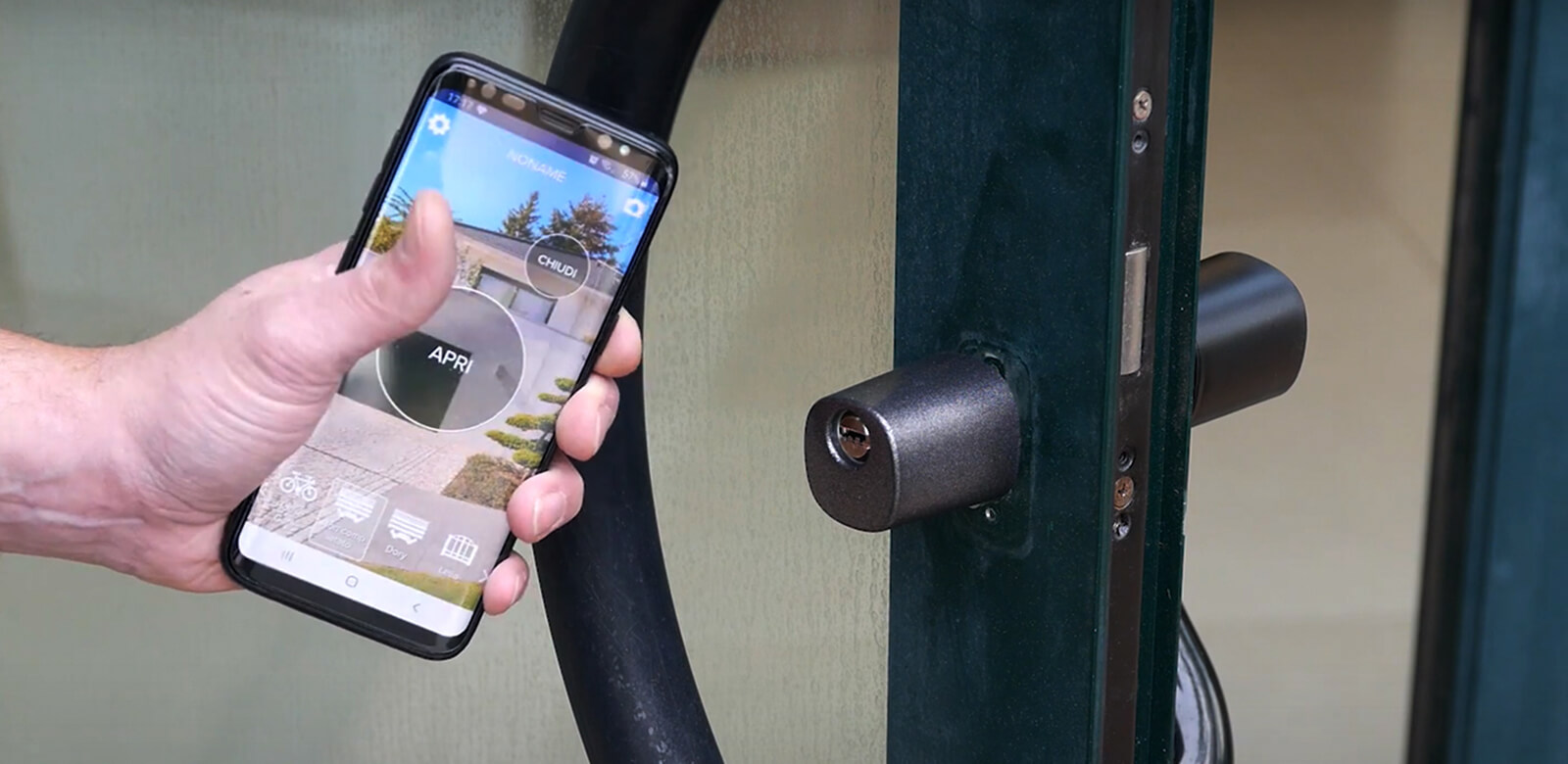
The choice between an electronic door lock and a traditional mechanical lock is no longer about technology enthusiasts versus pragmatic homeowners. It is a real decision that millions of households are facing as the cost of an electronic lock drops, batteries last a full year, and the number of people who need timed access to the front door — cleaners, carers, parcel couriers, short-let guests, family members — keeps growing. The wrong choice is expensive in both directions: pick a traditional lock when you actually needed access flexibility and you keep cutting keys and worrying about who has the spare; pick a cheap electronic lock and you end up replacing batteries every two months, calling a locksmith because the motor froze, or — worst of all — losing access entirely when the manufacturer disappears.
This guide is not a feature list. It is a structured comparison built around the eight criteria that actually move the decision in practice: how the door opens, how access is granted and revoked, how the lock behaves when something fails, how long the battery really lasts, how secure each architecture is in the real world, how installation works, what the lock truly costs over five years, and who should choose what. The worked examples lean on 1Control DORY, the Italian electronic door lock built around a high-security European cylinder, because it sits in an unusual position: it keeps the traditional mechanical key fully working while adding smartphone control on top. That makes it a useful reference for understanding the trade-offs, regardless of which product you ultimately choose.
Want to skip the comparison and check whether an electronic lock fits your door? Discover 1Control DORY or check your door's compatibility in 60 seconds before reading on.
The 60-second answer (a verdict before the analysis)
If you live alone, rarely share access, and your current cylinder is rated against modern attacks, a traditional lock is the rational choice: simpler, cheaper, no batteries, no app, no failure modes you do not understand. If you have a household with rotating access — children, cleaners, carers, short lets, a small office — an electronic lock pays for itself within months in time saved on key handovers and in the elimination of the "who has the spare?" anxiety. If you want the second without giving up the first, a hybrid electronic lock that keeps the mechanical key as a permanent backup — the architecture DORY is built on — removes the trade-off entirely.
The mistake to avoid is treating the comparison as a binary "old vs new". The honest answer is that the two products serve different use cases, and the hybrid architecture exists precisely because the use case "I want flexibility without the failure modes" is the most common one in real households.

Explore DORY before checking your door
See how it works, compare DORY MINI, MINI + LINK and DORY, then check in a few steps whether your cylinder and door are compatible.
What "electronic door lock" actually means (vs smart, vs keyless)
Search queries mix half a dozen overlapping terms — electronic door lock, smart lock, smart door lock, keyless entry, Bluetooth lock, Wi-Fi lock, digital lock, biometric lock. In daily English, they describe the same family of products. In technical specifications, they describe meaningfully different architectures. Understanding which is which decides whether you end up with the product that matches your need.
An electronic door lock, in its broadest sense, is any lock that integrates an electronic component into the unlocking sequence. That includes hotel keycard locks, office badge readers, safe locks with a keypad and consumer-grade smart locks for residential doors. It is the umbrella term. A smart lock is the consumer-residential subcategory of electronic lock, distinguished by app integration, virtual keys for guests, and an access log. A keyless entry lock describes the user-facing benefit rather than the architecture: opening your door without inserting a metal key, either from a phone, a smartwatch, a PIN keypad or a proximity tag.
Inside the smart-lock category, the architecture varies. A motorised smart lock sits on the inside of the door and uses an electric motor to physically rotate your existing thumb-turn — it does not replace the cylinder, it drives it. A retrofit cylinder smart lock, like DORY, replaces the European cylinder itself with a unit that has electronics inside the cylinder body, a mechanical key path that is independent of the motor, and Bluetooth Low Energy on the radio side. The two architectures share the same product category but behave very differently on battery life, noise, installation effort and what happens when something fails.
Biometric locks add a fingerprint reader or a face-recognition module either instead of, or alongside, the app. They are a feature, not a separate category — many biometric locks are smart locks at heart, with an extra authentication channel on top. Wi-Fi locks connect directly to the home network without an intermediary hub. Bluetooth locks connect to the phone in proximity and rely on an optional hub for remote operation. The choice between the two is mostly a battery-life choice: a Wi-Fi radio kept awake consumes ten to twenty times more power than a BLE radio in idle.
For the rest of this guide, "electronic door lock" and "smart lock" are used interchangeably to refer to consumer-grade products for the front door, with explicit qualifiers when the architecture matters.
What a traditional lock still does best
Before celebrating what electronic locks can do, the case for the traditional lock has to be stated honestly. A modern high-security European cylinder — built to EN 1303 grade 6 or higher, with anti-pick, anti-bump, anti-snap and anti-drill features, paired with a security door defender — is a quiet engineering masterpiece. It survived a century of consumer testing, it has zero electronic dependencies, and a competent locksmith can rekey or replace it in twenty minutes. Most front doors in residential Europe still ride on this technology, and they do their job well.
The strengths of the traditional lock are durability, simplicity and predictability. There is no battery to replace, no firmware to update, no app to keep installed on a phone that you may upgrade three times in the next five years. The mechanical security level is fully decoupled from any electronic vulnerability: a sufficiently advanced cylinder resists bumping, snapping and picking by virtue of mechanical geometry, not cryptography. The initial cost — typically between €80 and €150 for a high-security cylinder plus five mechanical keys — is the only cost; there is no recurring expense unless you lose a key and need a copy made.
Traditional locks also have a credibility halo with insurers. Many residential insurance policies in Europe still write their conditions around mechanical certifications — cylinder grade, the presence of a defender, anti-snap features — and a traditional lock with the right certifications has a clear, well-documented compliance profile. Electronic locks are catching up, but the certification path is younger and varies between markets.
The honest limit of the traditional lock is not security: it is access management. The traditional lock has exactly one mode of operation — present the right key, the door opens. There is no audit trail, no time-bound access, no way to revoke a key short of replacing the cylinder. For a single resident with stable habits, that is not a limitation. For anyone who shares the door with rotating users, it is the central problem the rest of this guide is about.
Head-to-head: an eight-criteria comparison table
Before going into individual sections, the table below summarises how a representative traditional lock, a representative generic electronic lock and a hybrid electronic lock like DORY compare on the eight criteria that actually move the buying decision. Each row is unpacked in detail in the sections that follow.
| Criterion | Traditional mechanical lock | Generic electronic lock | Hybrid electronic lock (DORY) |
|---|---|---|---|
| Entry methods | Mechanical key only | App, optionally PIN, sometimes a backup key | Mechanical key, app, smartwatch, optional PIN, optional voice via hub |
| User management | Physical key duplication required | Digital invitations through the app | Digital invitations through the app, mechanical keys preserved |
| Temporary access | Practically impossible | Time-windowed shares | Time-windowed shares, revocable instantly |
| Access log | None | Available in-app | Available in-app, locally and via optional hub |
| Battery life | Not applicable | Typically 2 to 3 months | About 12 months on two CR2 lithium cells |
| Lockout risk | Only if the key is lost | Possible if the battery dies and there is no backup path | Effectively eliminated by the mechanical key fallback |
| Installation | Cylinder swap, often by a locksmith | Cylinder or thumb-turn swap, DIY-grade with caveats | European cylinder swap, DIY in ~10 minutes, reversible |
| 5-year total cost | ~€80-150 | ~€280-400 + recurring battery cost | One-off purchase (lock + optional hub), minimal recurring cost |
Two patterns emerge from the table. The traditional lock wins decisively on simplicity and initial cost. The electronic locks win decisively on access management and convenience. The hybrid architecture wins where the two trade-offs that usually trip up electronic locks — battery anxiety and lockout risk — are designed out. The rest of the guide explains each row.
Security: mechanical attacks vs digital attacks
The instinct says traditional locks are more secure, because they have no electronics that can be "hacked". The data tells a more nuanced story: the realistic threat to a residential door in Europe is not a remote cyber-attack on a Bluetooth radio — it is mechanical attacks against the cylinder, and they affect both traditional and electronic locks identically when the cylinder is the same.
The dominant mechanical attack today is cylinder snapping: a thief grips the protruding cylinder with mole grips and snaps it at the cam, exposing the internal mechanism in seconds. Anti-snap cylinders, certified to TS007 in the UK, SS 312 in Sweden or to the equivalent grade-6 specification of EN 1303 across the European Union, are the answer. Bumping — using a specially cut key tapped with a hammer to align the pins by inertia — is the second most common attack; anti-bump pin profiles defeat it. Picking, the romantic attack of fiction, is rare in real burglaries and is the easiest of the three for any mid-range security cylinder to resist. A high-security European cylinder with anti-snap, anti-bump and anti-pick certifications resists all three regardless of whether there is an electronic motor attached to it.
On the digital side, the realistic attack surface of a Bluetooth Low Energy smart lock is limited to two scenarios: replay attacks against the authentication exchange between phone and lock, and exploitation of a firmware vulnerability. Both are mitigated by modern AES-grade cryptography with rolling session keys, the same family of techniques that protects online banking and contactless cards. The lock-specific attack that has occasionally been demonstrated in security research — physical extraction of the firmware from a stolen unit — is irrelevant to a resident with the lock installed on their door.
The pragmatic conclusion is that security at equal cylinder grade is comparable between a traditional lock and a serious electronic lock. The electronic lock adds two dimensions the traditional lock cannot match: an audit trail that tells you who opened the door and when, and the ability to revoke compromised credentials instantly — if a key disappears or an employee leaves, revoking their access is a tap, not a cylinder swap. DORY plays this story conservatively: it uses a high-security European cylinder co-engineered with OMEC for the mechanical layer, encrypted Bluetooth LE for the digital layer, and treats the mechanical key as the unbreakable fallback. Two independent layers, not one replacing the other. For a deeper analysis of how the DORY cylinder compares to the architectures used by Nuki and Yale, see the Nuki vs DORY comparison.
Convenience: the daily-friction question
Security gets the headlines, but the practical reason most people install an electronic lock is the daily friction of managing access. A traditional lock has one degree of freedom: who holds a physical copy of the key. Every time access needs to be granted, a key has to be cut and handed over; every time access needs to be revoked, either the cylinder is changed or the user is trusted to return — and remember to return — the spare. With more than two or three users, the entropy is impossible to manage.
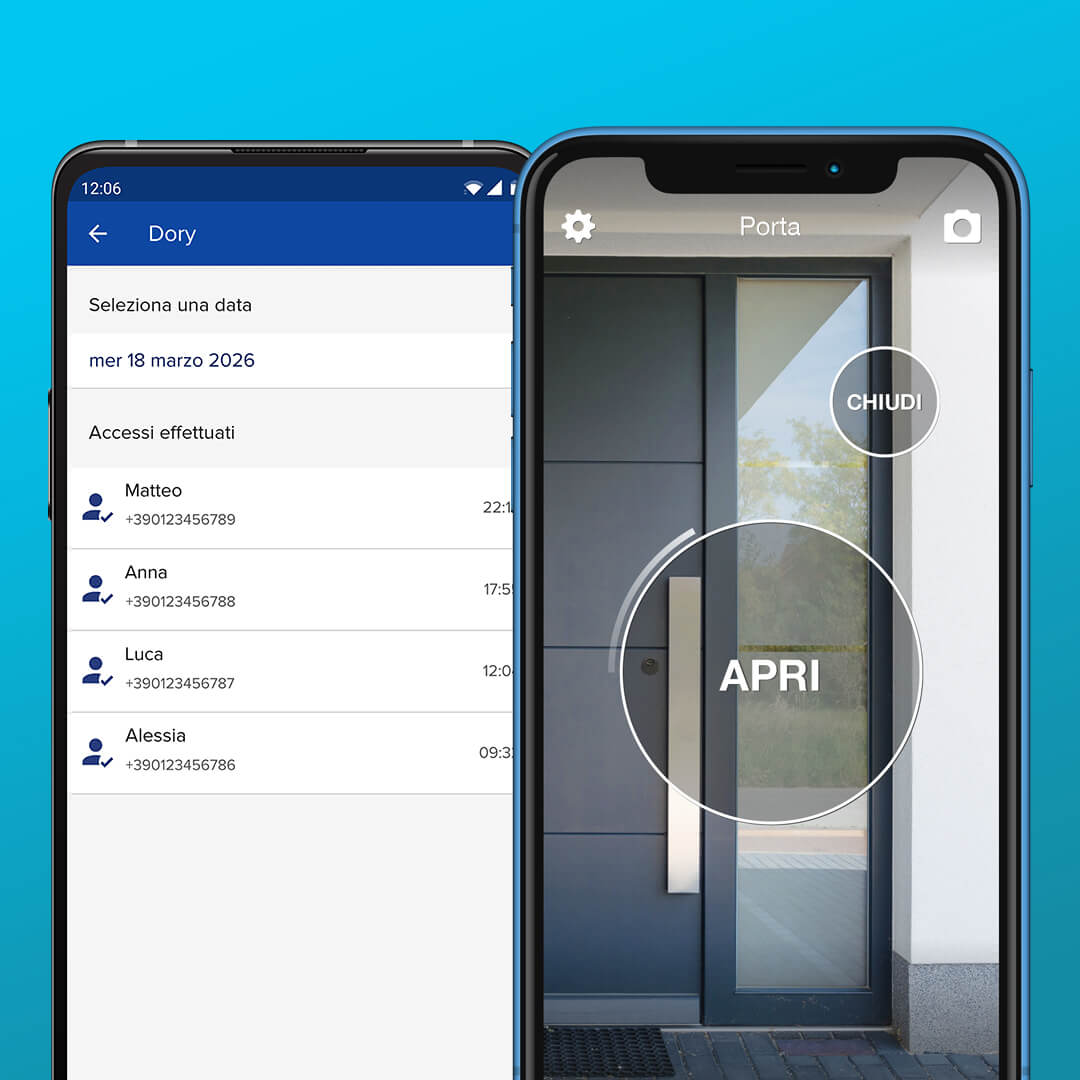
An electronic lock changes the unit of access from "metal key" to "digital invitation". A digital invitation is created in the app, can have time windows attached (only Mondays 09:00 to 18:00, only the weekend of a given month), can be revoked instantly without involving the user, and leaves an audit trail. The cost of granting and revoking access drops from ~€10 plus a key-cutting trip to a single tap.
The unlock methods themselves multiply. Beyond the mechanical key (always preserved in a hybrid lock like DORY), the lock can be opened from a smartphone app in proximity over Bluetooth, from a paired smartwatch, from a separate PIN keypad like 1Control PAD mounted next to the door, and — with the addition of the optional 1Control LINK hub — through voice assistants (Alexa, Google Home), Apple CarPlay or Android Auto, and remotely from anywhere in the world.
Three concrete examples make the difference visible. A family of four with a cleaner who comes on Thursday mornings: the cleaner gets a digital invitation valid only between 08:00 and 11:00 on Thursdays — she never holds a physical key. A short-let host running a weekly Airbnb: each guest receives a PIN code valid for the duration of their stay, generated automatically when the booking calendar pushes a new reservation. A small office of six people: each member of staff has their own credential, the office manager pulls the access log on Monday morning, and when someone leaves the team their access is revoked in two seconds. None of these workflows are possible with a traditional lock.
For a deeper look at the various unlock methods and how they compare, the keyless entry smart locks guide covers each method in detail, from BLE app opening through to geofencing and voice control.
Battery life — why 12 months matters and how it is achieved
The biggest practical complaint against electronic locks is the battery. A lock that needs new batteries every two months is a lock that gets resented — and eventually, when you forget the third change, locks you out. The honest data on the market is that most consumer smart locks last between 6 weeks and 3 months on a fresh set of cells in normal residential use. That is the reality, regardless of marketing claims, for the dominant architecture: an external motor that physically turns the existing thumb-turn on every opening, drawing a high-current pulse from AA alkaline cells.
The reason DORY reaches about twelve months on two CR2 lithium cells is a combination of three architectural decisions taken at design time, not a battery-capacity gimmick. First, the motor is integrated inside the cylinder body and engineered to be small and silent: it does not have to overcome the inertia of an external thumb-turn, it acts directly on the locking mechanism through a short, efficient drivetrain. Second, the radio is Bluetooth Low Energy, not Wi-Fi: BLE idle current is one to two orders of magnitude lower than Wi-Fi idle current, and a connected lock spends ~99.99% of its time idle. Third, the chemistry is CR2 lithium, which holds voltage stably down to deep discharge — unlike alkaline AA cells, which lose voltage gradually and force the lock to consume more current to overcome the lower voltage, accelerating discharge.
The user-visible difference is the elimination of battery anxiety. A 12-month interval is short enough to be a single annual maintenance task — "change DORY batteries when the clocks change in October" — and long enough that nobody forgets. Two-month batteries are too frequent to anchor on a memorable date and too rare to enter daily routine, which is the worst possible interval: people forget, the lock dies, the resident is locked out.
For a side-by-side battery breakdown with named competitors, see the Nuki vs DORY comparison, which analyses the exact reasons motor-on-the-thumb-turn locks consume more energy than retrofit cylinder locks.
The lockout question — what fails and how to recover
An honest assessment of any electronic device has to include its failure modes. There are four realistic ones for an electronic lock, and they are the deciding factor for many buyers who would otherwise prefer the convenience of digital access.
Failure mode 1 — battery dies completely. On a traditional lock, this does not exist. On a generic electronic lock, the consequences depend on whether the manufacturer provided a fallback: some include an external 9V terminal to wake the lock briefly, some require an emergency mechanical key, some leave you waiting for a locksmith. On DORY, the mechanical key keeps working through the cylinder regardless of battery state — the mechanical path is independent of the motor. The failure mode is reduced to "carry the spare key when you go on holiday, just in case".
Failure mode 2 — phone is lost, stolen or dead. Generic electronic locks with no PIN backup and no mechanical key require waiting for a replacement device, recovering the account, and waiting for the lock to re-pair. On DORY, the mechanical key still opens the door — no waiting, no support call, no recovery flow. The user is exactly where a traditional-lock user would be: in possession of a metal key.
Failure mode 3 — the app crashes, the firmware glitches or the manufacturer's servers go down. Cloud-dependent locks lose remote features and, in the worst case, lose the local unlock too. BLE-first locks like DORY keep working in local mode regardless of cloud state, because the proximity unlock does not route through the manufacturer's servers. The mechanical key, as always, is the final fallback.
Failure mode 4 — the manufacturer goes out of business or discontinues the product. This is the failure mode buyers tend to underweight at purchase time and the one with the largest long-term impact. A discontinued lock that relies on the manufacturer's cloud becomes a non-functioning lock as soon as the servers go dark. The defence is architectural: choose a lock whose local mode does not require the manufacturer's cloud, and that preserves the mechanical key. With those two properties together, a vendor change cannot brick your front door.
The failure-mode table is the single strongest argument for the hybrid architecture. It is also the reason DORY treats the mechanical key as a permanent feature rather than an emergency override: it removes three of the four failure modes from the conversation.
Total cost of ownership over five years
The sticker price is the smallest part of the long-run cost. The honest comparison includes batteries, additional copies of keys (mechanical or digital), the cost of changing the cylinder when staff or tenants turn over, the locksmith call-outs for lost keys, and — if you are running a short let or a small office — the time cost of managing physical key handovers. Five years is a reasonable horizon: it covers the warranty window of most products and approximates the typical residency duration in European urban housing.
The numbers below are realistic averages for a household in Western Europe at 2026 retail prices. Local pricing varies — but the relative gap between the three architectures is consistent across markets.
| Cost item (5 years) | Traditional lock | Generic electronic lock | Hybrid lock (DORY + optional LINK) |
|---|---|---|---|
| Initial price | €80-150 (cylinder + 5 keys) | €220-330 (lock + bridge) | One-off purchase (lock + optional hub) |
| Batteries over 5 years | €0 | €80-120 (AA, 4-6 sets/year) | ~€25 (CR2 lithium, 1 set/year) |
| Additional keys / shares | €10-15 per copy, ad infinitum | €0 for digital shares | €0 for digital shares; extra mechanical keys ~€15 |
| Cylinder swaps after staff turnover | €80-150 per swap | €0 (revoke digitally) | €0 (revoke digitally) |
| Emergency locksmith for lost keys | €100-200 per event | €0 if backup exists | €0 (mechanical fallback always present) |
| Time managing physical handovers | High, hidden cost | Eliminated | Eliminated |
For a single-resident household with stable habits, the traditional lock is the cheapest option by a clear margin. For any household with rotating access, the electronic lock breaks even within 18-36 months and turns positive thereafter — and the soft cost of saved time tends to be larger than the hard cost of the lock itself. The hybrid architecture costs a little more upfront and saves it back on battery replacements and on the elimination of lockout-driven locksmith calls. The decision is rarely about which architecture is cheapest: it is about which architecture matches the access pattern of the household.
Installation reality — retrofit without modification
A surprising fraction of would-be smart-lock buyers stop at the installation step. The mental image is wiring, drilling, an expensive specialist visit, irreversible damage to the door — and a lease clause that forbids any of it for renters. The reality, for European-cylinder retrofit locks like DORY, is much milder.
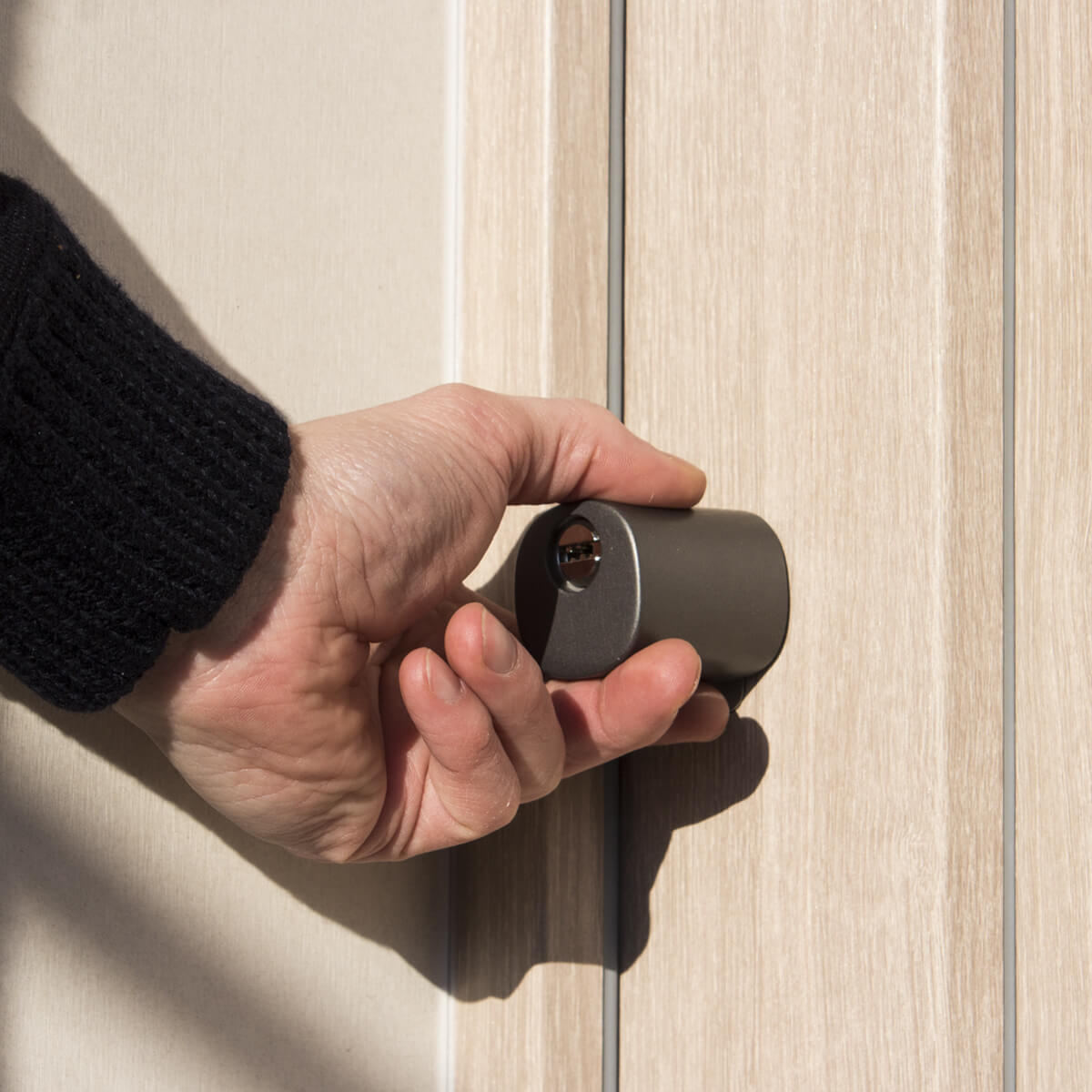
The European cylinder is a standardised mechanical interface defined by DIN 18252. Almost every residential and commercial door fitted in Europe in the last forty years uses a cylinder that complies with this standard. Replacing the cylinder is a routine operation that consists of unscrewing a single retaining bolt at the side of the lock case, sliding the existing cylinder out, sliding the new one in, and retightening the bolt. No drilling, no wiring, no changes to the door, the frame or the handle. The whole process takes about ten minutes with a single screwdriver and a free hand.
The catch is dimensional fit. European cylinders come in varying lengths — typically 30+30 mm, 35+35 mm, 30+40 mm and so on — and the precise length depends on the door thickness and the depth of the cylinder seat in the lock case. DORY ships with a set of mechanical extensions to handle the common cases, and 1Control provides an online compatibility checker that walks through measuring the existing cylinder with a piece of cardboard and outputs the exact extension combination you need before you order. That five-minute pre-check is the difference between an installation that takes ten minutes and a return-to-vendor scenario.
The reversibility of the installation matters disproportionately for renters and tenants. Because the original cylinder is unmodified by the swap and can be refitted at any time, the operation is fully reversible: when the tenant moves out, the original cylinder goes back in, the smart lock goes into the box, and the door is in the exact mechanical state it was at move-in. That property turns a smart lock from a homeowner-only product into a tenant-friendly one. If you are starting from a fully unsmart house and want to know where to begin, the smart home beginner guide covers the first three devices to install.
The hybrid lock — when you do not have to choose
The recurring conclusion in each previous section is the same: most of the failure modes that scare buyers away from electronic locks are properties of specific architectures, not of electronic locks in general. Replace an external motor turning a thumb-turn with a silent motor integrated into the cylinder, replace AA alkaline cells with CR2 lithium, replace a cloud-only model with a BLE-first model with optional cloud, and keep the mechanical key as a permanent feature — and most of the objections disappear.
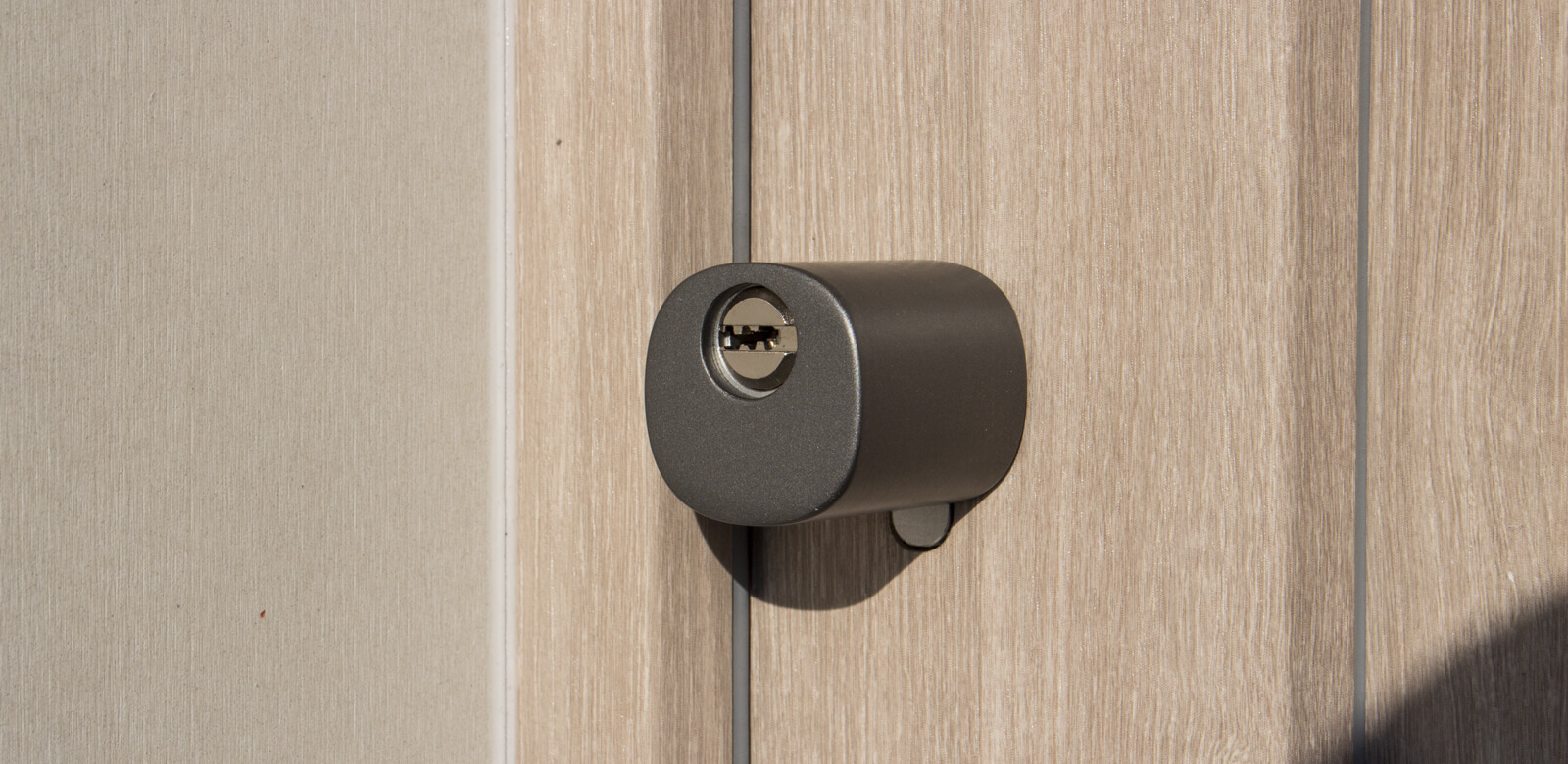
That is the design space DORY occupies. The product is a hybrid in a precise sense: it is electronically a smart lock with all the access-management features described above, while remaining mechanically a high-security European cylinder lock with all the durability and predictability described in the "traditional lock" section. The two layers are independent. The motor can fail, the firmware can glitch, the manufacturer can disappear — the mechanical key still opens the door. Conversely, the mechanical layer can degrade with age or wear — the electronic motor still operates as long as the cylinder physics are intact.
The architectural details that matter, in order of importance: dual-knob design with an electronic interior and a mechanical exterior that idles unless the electronic layer authorises, so the cylinder cannot be forced open by twisting it from outside; CR2 lithium chemistry with a ~12-month replacement interval; a silent integrated motor that does not signal openings audibly to anyone nearby; BLE-first connectivity so the daily unlock works without any cloud or internet; the optional 1Control LINK hub if and only if the user actually wants remote opening and voice control; and a mechanical key path designed in from day one, not bolted on as an emergency override.
The position is consistent with the broader 1Control product philosophy of designing for graceful degradation: every layer can fail without taking the entire product down. Made in Italy, patented design, no subscription fees, no cloud account required for core functionality. Discover 1Control DORY if this is the architecture you want at the front door.
Buyer profiles — who should pick which
Generic recommendations are useless. The right product depends on the actual access pattern of the household, the willingness to absorb modest complexity in exchange for flexibility, and the budget horizon. Across thousands of support tickets and customer interviews, four profiles cover the vast majority of decisions.
Profile 1 — Single resident with stable habits, no rotating access. The honest recommendation is a high-grade traditional cylinder. The benefits of access management are not in your daily routine; the cost and complexity of an electronic lock are real and unrewarded. Choose an EN 1303 grade 6 cylinder with anti-snap, anti-bump and anti-pick certifications and stop there.
Profile 2 — Family with rotating access. Couple with teenage children who lose keys, a recurring cleaner or carer, relatives who pop in. The access management problem is real; an electronic lock pays for itself in months. The deciding feature is the audit trail and time-bound shares. A hybrid lock like DORY removes the lockout anxiety many parents have about smart locks; if anyone in the household is uncomfortable with apps, the mechanical key still works for them.
Profile 3 — Short-let host (Airbnb, Booking, holiday cottage). Weekly turnover, guests arriving at unpredictable times, impossible to be there for every check-in. The economics are unambiguous: every booking that does not require a physical key handover pays back a chunk of the lock cost. The deciding feature is the integration with the booking calendar and the ability to generate PIN codes for guests via a paired PAD keypad. A hybrid lock with mechanical fallback also reassures guests who are nervous about being locked out of an unfamiliar property.
Profile 4 — Small office or professional practice. Six to twenty people, occasional turnover, an office manager who would rather not deal with cylinder swaps every time someone leaves the team. An electronic lock with per-user credentials and instant revocation is the right answer. The mechanical key fallback matters less in an office context but adds resilience for the first person in on Monday morning if anything has gone wrong overnight.
The thread across all four profiles is that the question is not "electronic versus traditional" — it is "does my access pattern justify the complexity of an electronic lock, and if yes, what architecture protects me from the failure modes I cannot tolerate?". The hybrid architecture is the most conservative answer for anyone who lands in profiles 2, 3 or 4.
What can go wrong (and how to prevent it)
The honest review of any product category includes the failure modes that real users hit. For electronic locks, the patterns are predictable and can be mostly avoided with deliberate purchasing choices.
Buying the cheapest option. The market floor for electronic locks is occupied by white-label products with short battery life, brittle motors, opaque firmware and a cloud dependency on services that may not exist in three years. The savings on day one are recovered, with interest, in maintenance and replacements. The pragmatic minimum is to choose a lock from a manufacturer with a multi-year track record, with batteries in a chemistry that genuinely lasts the year, and with a clear non-cloud unlock mode.
Skipping the compatibility check. The "lock does not fit my door" return is the most common cause of disappointed first-time buyers. Five minutes spent with the cardboard cylinder gauge and the online compatibility checker before ordering eliminates the problem entirely. The check itself is free; the cost of skipping it is the time of a return.
Trusting a single point of failure. A lock that depends only on the app, only on the cloud, or only on a single battery type is fragile. The architectural rule of thumb is to have at least two independent unlock paths — for example app + mechanical key, or PIN keypad + mechanical key — so that a failure in one path does not lock out the user. Hybrid locks like DORY make this rule explicit; the mechanical key is the permanent second path.
Underestimating vendor longevity. The smart-lock market still has high churn. Manufacturers come and go; cloud services get sunset; apps stop receiving updates. The defence is to favour locks whose local mode is independent of the manufacturer's cloud. A DORY whose vendor disappeared tomorrow would keep opening from the mechanical key forever and from the existing paired phones over BLE for as long as the phones support the relevant Bluetooth profiles.
Forgetting to revoke departed users. The audit trail and instant revocation features are powerful — but they only work if the user actually uses them. Treat departed staff, ex-flatmates and former cleaners as a standing maintenance task; the time cost is seconds per event and the security gain is large.
Common myths debunked
Five recurring objections circulate about electronic door locks. None survives a careful look at the data.
"Electronic locks can be hacked easily." Realistic remote attacks against modern BLE smart locks are rare in published security research and almost non-existent in residential burglary statistics. The dominant break-in technique in Europe is still cylinder snapping, which a serious electronic lock with a high-security cylinder resists as well as a traditional lock would. The honest threat model worries about mechanical attacks and lost keys, not about cyber-attacks.
"Smart locks need internet to open my door." Architecture-dependent and increasingly false. BLE-first locks like DORY open from a phone in proximity without any internet involvement. Internet is required only for remote features — opening from outside the home, voice assistants, push notifications, access history — which are optional and require the addition of an external hub.
"If you install a smart lock, you lose the physical key." True for some specific architectures, false for retrofit cylinder locks with a mechanical key path. On DORY, the mechanical key is preserved as a permanent feature, not as an emergency override. The decision is the manufacturer's design choice, not a constraint of the technology.
"Smart lock batteries are a constant hassle." True for products with poor battery design — typically external-motor locks running on AA alkaline cells, which last 2 to 3 months. False for products engineered around long-life chemistries and efficient motors. A 12-month interval, like DORY achieves, is a once-a-year maintenance task that fits any reasonable household routine.
"Electronic locks are for tech enthusiasts, not for serious security." Cleanly false at the high end of the market. The cylinder grade is independent of the electronic layer; a serious electronic lock combines an EN 1303 grade 6 cylinder, anti-snap, anti-bump and anti-pick features, and AES-grade Bluetooth cryptography. The aggregate security posture is at least as strong as a high-end traditional lock and adds an audit trail.
Frequently asked questions
Is an electronic door lock as secure as a traditional one?
Yes, if it is built on a high-security European cylinder and adds encrypted Bluetooth Low Energy on top. The mechanical security rating is unchanged; the digital layer is additional. 1Control DORY uses a high-security European cylinder co-engineered with OMEC plus AES-grade cryptography for unlock commands, so the mechanical strength of the lock is preserved and the electronic channel is independently protected.
Can I still open the door if the battery is dead?
With most motorised smart locks, no — you need an external power source, a backup keypad or an emergency key. With DORY the original mechanical key always works, even with completely discharged batteries, because the cylinder retains its standard mechanical interface. The mechanical path is independent of the motor and of the firmware.
Does an electronic door lock need an internet connection?
Not for the lock itself. DORY communicates locally with your phone over Bluetooth Low Energy; no internet, no cloud account, no server registration is required to open the door from proximity. Internet is only needed for remote unlock, voice assistants and entry history, which require the optional 1Control LINK hub.
Will I have to modify my door to install an electronic lock?
A European-cylinder retrofit electronic lock like DORY does not require drilling, wiring or frame modification. You swap the existing cylinder in about ten minutes with a single screwdriver. The operation is fully reversible — you can refit the original cylinder at any time — which makes it suitable for rented homes and tenancy agreements.
How long do batteries last on a quality electronic door lock?
It depends on motor design and radio idle behaviour. Many smart locks on the market last around two months because the motor physically turns the key on every opening. DORY uses a silent motor integrated into the cylinder and dual CR2 lithium cells, and reaches about twelve months of typical residential use before replacement.
Can I give temporary access to a guest, a cleaner or a short-let guest?
That is one of the strongest reasons to choose an electronic lock. You issue a time-windowed digital invitation from the 1Control app — defined day, time slot and number of accesses — and revoke it instantly. With a traditional lock the equivalent would be cutting and handing over a physical key, with no way to revoke it.
What happens if the manufacturer goes out of business or stops the app?
With DORY two safety nets exist: the mechanical key keeps working independently of the company and the app, and the Bluetooth unlock operates locally without cloud. You never end up with a non-functioning door because of a vendor change, an app discontinuation or a service shutdown.
Should I buy an electronic lock if I live alone and rarely share access?
Probably not as a security upgrade — your existing high-security European cylinder already does its job. The reason to switch is convenience: no keys to carry, smartwatch unlock, holiday access for a relative, instant revocation. If those benefits are not part of your daily routine, the traditional lock remains the rational choice.
The bottom line
The choice between an electronic and a traditional door lock is not a generational war. The traditional lock is a mature, reliable piece of engineering that still wins on simplicity, initial cost and predictability. The electronic lock wins decisively on access management, audit and convenience for any household with rotating access. The hybrid electronic lock — the architecture DORY is built around — removes the trade-off by keeping the mechanical layer fully intact and adding the electronic layer on top, with independent failure modes for both.
If you live alone and rarely share access, stay with a high-grade traditional cylinder. If you have a household, a short let or a small office with rotating users, an electronic lock pays back its cost within months. If you want the second without giving up the first, a hybrid lock is the conservative answer. For a deeper buyer-side analysis with named competitor comparisons, the complete smart lock buyer's guide covers the strategic decision in detail.