When people search Google for Nuki smart lock, they are rarely choosing a specific model: they are evaluating a category. The query is the starting point for anyone thinking of making their front door intelligent, who has heard the Austrian brand mentioned somewhere — at a tech conference, on a YouTube review, in an Airbnb host group — and wants to understand whether it is the right buy, or whether there are serious alternatives. This guide is exactly that comparison: Nuki or 1Control DORY? No cheerleading, no hatchet jobs.
Nuki and DORY belong to two different families of smart lock for the home. Nuki is an external motorised smart lock: it bolts onto the inside thumb-turn and a small motor physically rotates the existing key on every opening. DORY is a Euro cylinder swap: it replaces the lock cylinder on your door with a new electronic one. From that architectural difference flow three characteristics most buyers only discover after the purchase: a battery that actually lasts a year instead of a few months, a permanent mechanical backup key as fallback, and an opening that is genuinely silent. The rest of this guide compares them, criterion by criterion, on the points that matter in daily life. Both products are also true keyless entry systems — your phone, your smartwatch or a paired keypad replaces the metal key for everyday use. The final call is yours, and it hinges on one data point: compatibility with your specific door. For DORY you can settle that in about a minute with the compatibility tool before buying.
Comparison table — 8 criteria at a glance
| Criterion | 1Control DORY | External motorised smart lock (e.g. Nuki, Yale Linus L2) |
|---|---|---|
| Architecture | Electronic Euro cylinder, no drilling, no wiring (swap-in replacement) | External motor unit bolted onto the existing inside thumb-turn |
| Battery life in daily use | About 1 year (two CR2 lithium cells) | Typically 1–3 months on motorised models (varies with door and use) |
| Noise on opening | Silent — only the natural mechanical sound of the cylinder | Audible motor hum during key rotation |
| What happens when the battery dies | Mechanical key as a permanent fallback (battery lasts ~1 year: rare scenario) | Original key as fallback (battery 1–3 months: frequent scenario; some models accept an emergency power bank) |
| Remote opening | Yes, with the optional LINK hub | Yes, with the manufacturer's dedicated bridge |
| Voice and in-car | Alexa, Google Home, Siri Shortcuts, Apple CarPlay, Android Auto (via LINK) | Alexa, Google Home, Siri (typically via bridge) |
| Mechanical security | OMEC Euro cylinder, double-row pins, anti-duplication coded keys | Depends on the existing cylinder that stays in the door |
| Supply chain | Made in Italy with OMEC; manufacturer support in English | European and Asian brands depending on model |
The sections below unpack the differences one by one, with the technical "why" behind each. If you are short on time, jump straight to "Which one suits whom" further down.

Explore DORY before checking your door
See how it works, compare DORY MINI, MINI + LINK and DORY, then check in a few steps whether your cylinder and door are compatible.
Two architectures of smart lock
The category split is the key that unlocks everything else. Consumer smart locks today fall into two broad families.
The first is the external motorised smart lock: a compact device fitted to the inside thumb-turn of the door, gripping the existing key (or a dedicated duplicate) and physically turning it with an electric motor every time you open. The original cylinder stays in place untouched. This is the architecture of Nuki Smart Lock, Yale Linus L2, Tedee, August Smart Lock and various smaller brands. The main upside is that the cylinder itself is not modified; the trade-off is a visible device sticking out on the inside, a battery that drains in months rather than years, and a motor sound on every opening.
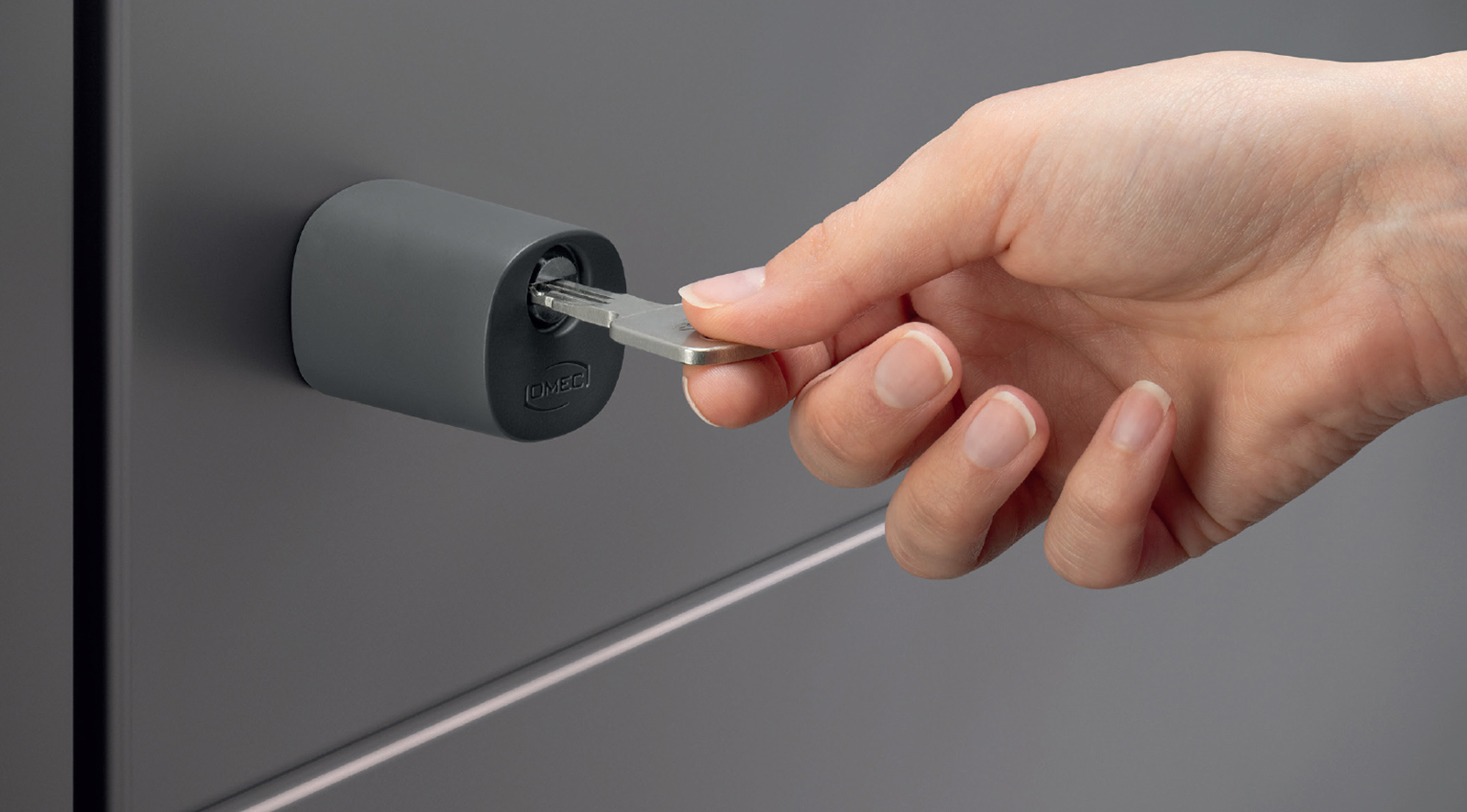
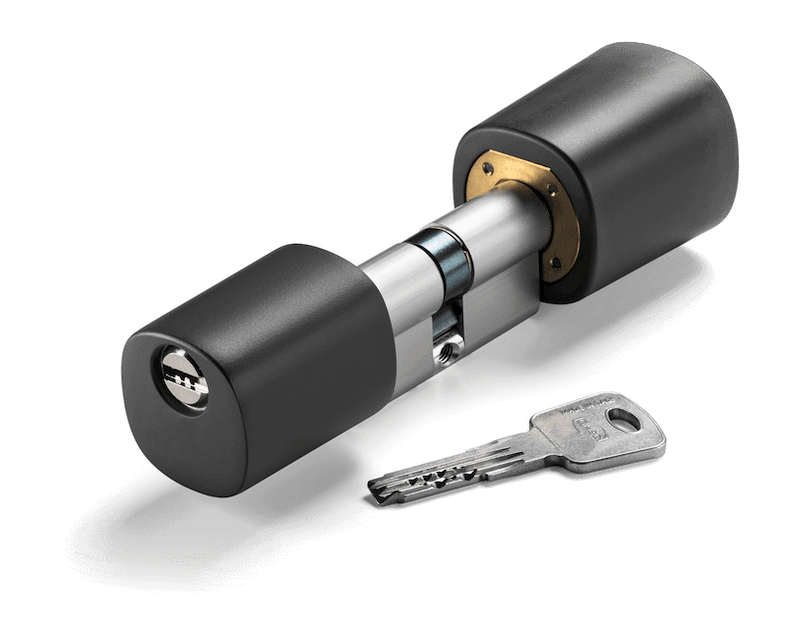
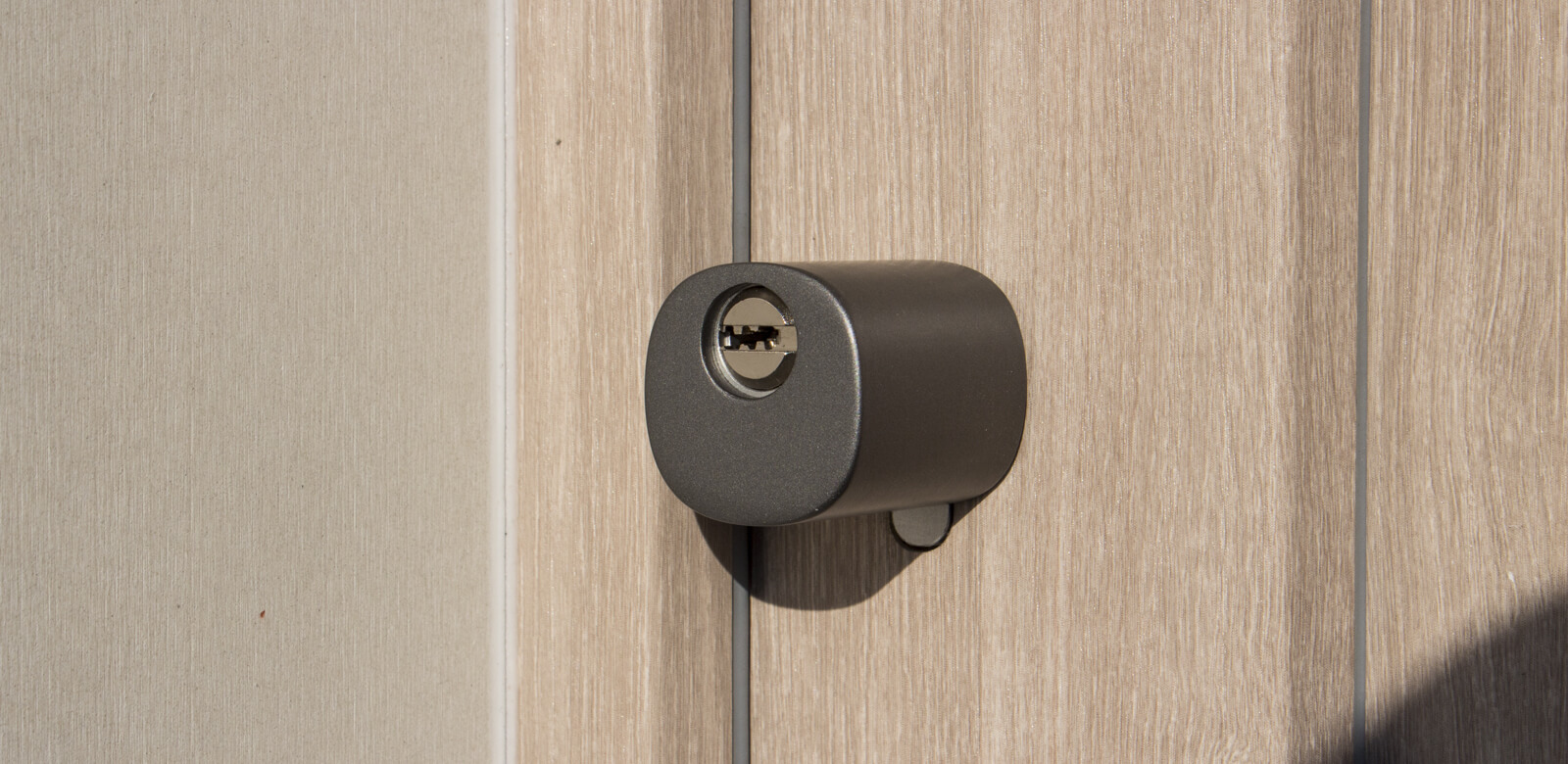
The second is the Euro cylinder smart lock: the European-profile cylinder of your door is replaced by a new cylinder that integrates the electronics and the unlocking mechanism inside it. This is DORY's architecture: from both sides the door looks completely normal, with two clean thumb-turns — one mechanical and one electronic. No bulky motor housing above the handle, no clamp gripping a key: the electronics enable or disable the rotation of the cylinder itself. The mechanical key keeps working fully in parallel, even with completely flat batteries.
This architectural distinction explains, on its own, most of the practical differences in battery life, noise, footprint, security and mechanical fallback. The sections that follow are simply consequences of this single split.
What happens when the electronics die
If a single argument decides this comparison in real-world scenarios, it is this: what happens when the electronics stop working? Batteries flatten, phones get lost, an app misbehaves after an OS update, the power can drop precisely when you need it. A serious smart lock has to give a calm answer to all of those scenarios.
With DORY the answer rests on two elements that work together. The first is the long-life battery: about a year of daily use, with the app warning you well in advance, so the "flat battery and I can't get in" situation is rare for anyone keeping a casual eye on the app. The second is the permanent mechanical key as a fallback: the cylinder is first and foremost a Euro cylinder built with OMEC, an Italian lock manufacturer with more than 65 years of history. The electronics sit on top, but underneath you still have a cylinder that turns with a physical key the way every traditional lock has done for a century — provided you carry the key with you. DORY's keys are also anti-duplication protected: copying them requires presenting the secret code printed on a card supplied in the box, a safeguard most standard cylinders lack.
With an external motorised smart lock the mechanical fallback exists in a similar way: the original cylinder is still in the door, so if you carry the original key with you, you can still let yourself in. The practical difference is how often you actually need that fallback: with a typical 1–3 month battery life, "flat battery" is a recurring scenario, and the physical-key backup becomes a real operational habit. For people who bought a smart lock precisely to stop carrying keys, that matters. Some manufacturers offer an emergency power-bank-style accessory you press against the unit for a one-off unlock; others fall back to the classic metal key.
From inside the home both architectures are equivalent: the indoor thumb-turn always rotates mechanically, even with dead electronics, so nobody ever gets locked in. The difference is all on the outside, and on how willing you are to trust a "digital key" without a permanent metal fallback sitting in the cylinder itself.
Battery life — why DORY reaches a year
Battery life is one of the most underrated specs before purchase and one of the most felt after. Most external motorised smart locks claim 1–3 months in average household use; on heavy doors or busy households they can fall short. The reason is structural: every opening requires a motor to overcome the friction of a standard cylinder and make several full turns of the key. That is significant energy, repeated every time you walk in or out.
DORY reaches about a year of typical daily use because, structurally, nothing physical moves by default: the electronics enable the cylinder to be unlocked, and you turn the thumb-turn yourself. There is no motor rotating the key on your behalf at every opening; there is a small actuator that engages the mechanism in milliseconds. The energy cost per opening is orders of magnitude lower.
The batteries are two CR2 lithium cells, swappable in a couple of minutes without removing DORY from the door. The 1Control app shows the charge level live and warns you well in advance. One scheduled swap a year, no anxiety.
Genuinely silent
Noise is the other direct consequence of the architecture. A motorised lock that physically turns a key produces an audible hum, even on well-engineered models. It is not invasive, but it is clearly heard from the other side of the door or in an adjacent room. In a single-family home it may not be a problem; in plenty of other situations it quickly becomes one.
DORY is genuinely silent. It works like a traditional lock: you only hear the natural mechanical sound of a cylinder turning, the sound everyone has lived with forever. No motor, no electric gear. It is the kind of detail you only notice after living a few weeks with the lock fitted. It matters for anyone with a bedroom next to the front door, for B&Bs and holiday lets with rooms close to the entrance, for shift workers coming home late in a house with small children or a baby.
Remote opening, voice control and integrations
This is where the comparison evens out: both architectures need a separate hub to unlock the door from the internet. Neither DORY nor external motorised smart locks are "pure Wi-Fi" devices — long battery life depends on staying on low-power Bluetooth, and a small hub bridges the lock to your home network whenever remote control is needed.
For DORY that hub is LINK: connects over 2.4 GHz Wi-Fi or Ethernet, talks Bluetooth LE to DORY and HTTPS to the 1Control cloud. When you send a remote-opening command from the app, the flow is encrypted end-to-end: app → authenticated cloud → LINK → DORY → cylinder. The same logic applies to external motorised smart locks, which use the manufacturer's own bridge for the same job.
The most relevant practical difference is ecosystem coverage: LINK supports not only DORY but also SOLO (smart gate opener) and LOCO (smart padlock). If, over time, you decide to make more than one access point intelligent — front door plus driveway gate plus shed padlock — you keep a single hub for everything, managed from a single app and a single account. For someone starting with the front door alone the difference is small; for anyone who later adds a gate or padlock it means no extra bridges and no extra subscriptions.
Voice control is well-covered on both sides: Alexa, Google Home and Siri Shortcuts open the door on command (the bridge has to be online). 1Control adds two integrations most competitors do not: Apple CarPlay and Android Auto. When you arrive home with shopping in both hands or in the rain, you unlock DORY straight from the in-car screen, without pulling out your phone. For a deeper view of the smart-lock category as a whole, see our complete smart lock and keyless entry buyer's guide; for context on the related gate-opener category, see our smart gate opener guide.

Installation and compatibility with security and composite doors
External motorised smart locks score well on installation: they bolt onto the inside thumb-turn with adhesive or a small clamp in minutes, leaving the cylinder alone. For many buyers that is the very reason they choose this architecture. The downsides — visible device, months of battery life, audible motor — are exactly the ones discussed above.
DORY installs in place of the existing cylinder in about 10 minutes, with one Allen key and the app as a guided walkthrough: measure the door thickness with the cardboard gauge in the box, pick the right extensions, unscrew the side fixing screw, slide the old cylinder out, slide DORY in. No cables, no drilling, no work on the handle or the frame. The extensions cover thicknesses from 60 mm to over 100 mm; for unusually thick doors there is a dedicated XXL kit.
On UK composite doors, multi-point locking systems and EU-style security doors, the extra consideration is the defender — the external escutcheon plate that protects the cylinder against snapping. It needs to leave enough clearance for the electronic outside knob. The DORY compatibility tool walks you through every check in about a minute. The operation is fully reversible: if you decide at any point to put the original cylinder back, you simply refit it. That is an important point for renters or for anyone who does not want to alter an expensive composite or security door permanently — the deposit-safe nature of a swap-in cylinder is a real advantage over bolted-on devices that mark the door.
Which one suits whom
Stripped down, the choice depends on what you put at the top of your priority list.
1Control DORY is the right call if:
- You want to minimise lockout risk: a battery that lasts about a year (one scheduled swap, with progressive warnings in the app) and a mechanical key as a permanent backup if you carry one.
- You have a bedroom adjacent to the front door, you run a B&B or short let, or you simply value a silent lock that does not announce every entry.
- You do not want to replace batteries every 2–3 months: with DORY it is one swap a year.
- You already have, or are planning to add, other 1Control devices like SOLO or LOCO: one LINK hub for the whole ecosystem.
- You value a Made-in-Italy supply chain with OMEC, English-speaking manufacturer support and a roadmap that is not subject to a brand vanishing overnight.
- You have a standard Euro cylinder on your door (the vast majority of European front doors, UK composite doors and modern security doors).
An external motorised smart lock (the Nuki / Yale Linus category) can be the right call if:
- You cannot or will not swap the cylinder for specific reasons (non-standard cylinder, rare leasehold or condo restrictions, personal preference).
- You want a totally non-invasive install on the cylinder itself, leaving it exactly where it is.
In both cases the one real pre-purchase check is the same: compatibility with your door. For DORY the dedicated tool is online and takes about a minute: check DORY compatibility. If it passes, a Saturday-afternoon install is genuinely easy; if it does not, you know before adding to cart.
Frequently asked questions
Can I unlock DORY if the battery is dead?
Yes, with the mechanical key supplied in the box, provided you carry one. It is a structural feature of the cylinder: even with completely dead electronics, the physical key keeps working like in any standard lock. External motorised smart locks (Nuki, Yale Linus, August) work the same way, since the original cylinder is left in place — you fall back on the original key. The practical difference is that DORY's battery lasts about a year instead of 1–3 months, so the "flat battery" scenario is rare and the physical-key fallback is needed far less often; the app warns you well before the cells go flat.
Does DORY work on a UK composite door or a security door?
Yes, in the vast majority of cases. Modern composite doors and EU-style security doors carry standard Euro profile cylinders (EN 1303), which is the format DORY is built for. The check is mainly the door thickness — handled with the included extensions, or the XXL kit for very thick doors. The compatibility tool walks you through the measurements in about a minute before you order.
How many users can DORY support?
The standard DORY supports 10 simultaneous app users, expandable up to 450 by purchasing additional users as a small one-off in-app fee. The DORY MINI version supports 3, also expandable. Each user can receive permanent access or time-bound shares (e.g. Mondays only, 9am–6pm only, only the weekend of 15–17 July). The access log records every opening with user, date and time.
Is DORY a true keyless entry smart lock?
Yes. Keyless entry means opening your door without inserting and turning a metal key — and that is exactly how DORY works in daily use: from the smartphone or smartwatch over Bluetooth LE, from the optional LINK hub when you are away from home, by voice through Alexa, Google Home or Siri, or from a paired keypad like 1Control PAD. The metal key still exists, but as a backup you carry in your pocket and almost never use — not as the everyday opening method.
Does DORY work with Alexa, Google Home, Siri and Apple CarPlay?
Yes, through the optional LINK hub. The Amazon Alexa and Google Home skills are official; with Siri you create a shortcut in the iOS Shortcuts app; with Apple CarPlay and Android Auto you unlock the door straight from the in-car screen. All of these require LINK connected to the home network, because voice and in-car experiences route through the internet by definition. Apple HomeKit is not currently supported.
Can I install DORY myself?
Yes. Installation takes about 10 minutes, one Allen key and the free 1Control app, which runs you step by step: measure the door with the included cardboard gauge, pick the right extensions, remove the old cylinder, fit DORY, run a test. No drilling, no wiring, no electrician needed. Video tutorials covering the full procedure are available on the 1Control website. The operation is reversible — the original cylinder can be refitted at any time, with no marks on the door, which is useful for renters and end-of-tenancy returns.
Conclusion
The Nuki vs DORY comparison comes down to three structural differences that flow from the architecture: a battery that lasts a year instead of a few months (which makes "flat battery" a rare event and the mechanical-key fallback more of a safety net than an operational habit), a permanent mechanical key as fallback included in the box, and a silent opening. On remote control, voice and integrations the gap is essentially closed — both worlds need a hub and offer mature integrations, with DORY adding CarPlay and Android Auto on top of the standard Alexa / Google / Siri trio. What is left are the soft-power differentiators of DORY: Made in Italy with OMEC, a unified 1Control ecosystem covering gate + door + padlock, English-speaking manufacturer support and a 30-day return policy.
If your top priority is leaving the cylinder untouched, an external motorised smart lock is a legitimate choice. If your priority is the calm of a front door that always opens, silently, with one battery swap a year and the metal key as a last-resort backup, DORY is designed for exactly that. Starting point: the DORY product page. To zoom out to the whole smart-lock category, read our complete smart lock and keyless entry buyer's guide.