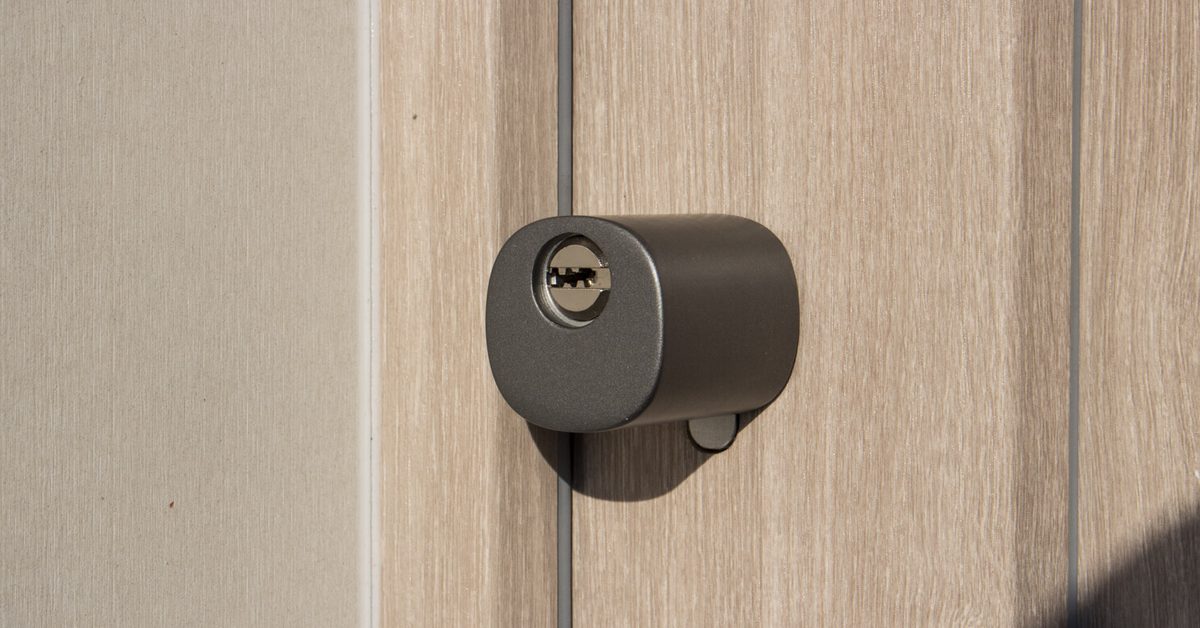
Needing to change a door lock sounds like a locksmith call-out but, on most modern UK doors, is genuinely a ten-minute DIY task. If your front door is uPVC or composite — as most fitted since the mid-1990s are — the lock you need to replace is a single euro cylinder held in place by one screw: no carpentry, no drilling, no tools beyond a Phillips screwdriver and a tape measure.
This guide covers the whole decision, not just the screwdriver part: when to change your locks, how to identify your lock type, how to measure a euro cylinder, the line between DIY and locksmith jobs, costs, tenants' options, and where a smart cylinder fits in if the lock is coming out anyway.
When should you change your door locks?
Locks do not need changing on a schedule, but four situations justify doing it promptly.
You have just moved house. When you buy or rent a property, you have no idea how many keys exist or who holds them — previous owners, cleaners, tradespeople, estate agents. Changing the locks on day one resets the key count to zero, and surveys suggest most UK homebuyers never do it.
You have lost your keys, or they have been stolen. A lost key is a risk; a lost key together with anything carrying your address is an open invitation. If the keys were stolen rather than mislaid, change the lock the same day.
After a break-in or attempted break-in. Even if the intruder did not come through the door, the police and most insurers will advise replacing any lock that may have been tampered with. An attacked cylinder can be weakened internally without visible damage.
The lock is worn out. A key that needs jiggling, a cylinder that sticks in cold weather, a mechanism that only turns with the door lifted — all signs of internal wear, and a lockout waiting to happen. Replace it before it fails.
First: identify your lock type
Before buying anything, work out which lock you are actually replacing. UK front doors use three main types, and the DIY difficulty varies enormously between them.
Euro cylinder (uPVC and composite doors). If your door is uPVC or composite and you lift the handle to lock it, you almost certainly have a euro profile cylinder: the barrel-shaped insert your key goes into, sitting inside a multi-point locking mechanism. The cylinder is the only part you need to change — the multi-point gearbox, handles and hinges all stay. This is the easy case, covered step by step below.
Nightlatch (the “Yale-type” lock). Common on wooden doors, especially in flats and terraced houses: a rim-mounted latch on the inside face that locks automatically as the door closes, opened with a key from outside and a knob from inside. Like-for-like replacement is a reasonable DIY job; changing size or type means new holes and more care.
Mortice deadlock (wooden doors). A lock body recessed into the edge of the door itself, operated by a traditional lever key, usually alongside a nightlatch. Insurers commonly expect a five-lever mortice deadlock conforming to BS 3621 on final-exit wooden doors — worth checking your policy wording, because fitting a lower-specification lock can affect cover.
How to measure a euro cylinder
Euro cylinders come in dozens of length combinations, and fitting the wrong one is the most common DIY mistake — a cylinder that sticks out too far beyond the door face is significantly easier to attack. Measuring the old one takes two minutes.
With the door open, find the fixing screw on the flat edge of the door, directly below (or above) the cylinder. The cylinder is measured in two halves from the centre of that fixing-screw hole: one measurement to the inside end, one to the outside end. A cylinder marked 40/50, for example, is 40 mm from the screw centre to one end and 50 mm to the other, 90 mm overall.
Measure both halves of your existing cylinder and buy a replacement with the same two numbers. The goal is a cylinder that sits flush with the door furniture, or protrudes no more than a couple of millimetres; if the old one sticks out noticeably, the replacement is the chance to correct it.

Changing the lock anyway? Make it smart
It's the same job: 1Control DORY replaces just your euro cylinder: open from your phone, with revocable temporary access and the mechanical key always available. Check in seconds whether your door is compatible. One-off purchase, no subscription.
299,00€ from 249,00€ VAT included
- 1,500+ reviews on Amazon, Facebook and Trustpilot
- Secure payments
- 2-year warranty
Step-by-step: changing a euro cylinder yourself
Total time: around ten minutes. Tools: one Phillips screwdriver. Do the whole job with the door wide open, so a mistake can never lock you out.
Step 1 — Remove the fixing screw
On the flat edge of the open door, in line with the cylinder, sits a single long screw — the cylinder fixing screw. Unscrew it completely and set it aside; you will reuse it.
Step 2 — Slide the old cylinder out
Insert the key and turn it slightly — 10 to 15 degrees either way — while gently pulling. This rotates the cam (the tongue in the middle of the cylinder) into line with the body so it can slide free.
Step 3 — Insert the new cylinder
Put the key in the new cylinder, turn it slightly to align the cam, and slide it into the housing until its screw hole lines up with the hole in the door edge. Do not force it: if it stops, the cam is not aligned — adjust the key angle and try again.
Step 4 — Re-fit the screw and test everything
Drive the original screw back in, snug but not over-tightened. Then test with the door still open: key from outside, key or thumb-turn from inside, handle up and down, lock and unlock several times. Only close the door once everything is smooth.
That is the entire job — and the same four steps in reverse put the old cylinder back, which matters for tenants, as covered below.
Nightlatch and mortice: DIY or locksmith?
Honest answer: not the same for both.
A nightlatch is a realistic DIY swap — with a caveat. Replacing an existing nightlatch with the same size and brand is mostly unscrewing the old case and cylinder and screwing on the new ones. Changing size or type means re-drilling the cylinder hole and repositioning the keep on the frame — a job for a confident DIYer only. If in doubt, price the job with a locksmith before drilling anything.
A mortice deadlock is a professional job. The lock body sits in a slot chiselled into the door edge, with a matching recess in the frame. Fitting a new one — or upgrading an old two-lever lock to a five-lever BS 3621 model — demands accurate chiselling on both, and done badly it weakens the very edge the lock is supposed to protect. A locksmith does it in under an hour; most DIYers should not attempt it on their front door.
How much does it cost?
No two honest answers contain the same figures: the cost of changing locks varies widely with four factors.
DIY versus locksmith. Doing it yourself, the only cost is the replacement lock or cylinder. Calling a locksmith adds labour, which usually exceeds the price of the part for a straightforward cylinder swap.
The lock you choose. A basic euro cylinder, an anti-snap high-security cylinder and a British Standard mortice deadlock sit at very different price points. On an external door, the security level of the cylinder is not the place to economise.
Urgency and time of day. A planned weekday visit is the cheapest way to hire a locksmith. Emergency call-outs, evenings, weekends and bank holidays all carry significant premiums — an out-of-hours lockout is the most expensive way to discover a worn lock.
Where you live. Locksmith rates in large cities, London especially, run well above the national picture.
Whatever the scenario: get a clear quote covering parts, labour and call-out before anyone starts work, and be wary of quotes dramatically cheaper than everyone else's.
Renting? What tenants can and can't do
Tenants have a genuine interest in changing locks — you have no more idea who holds old keys than a buyer does — but far less freedom to act on it.
Most UK tenancy agreements require the landlord's or letting agent's consent before altering the locks; even where the agreement is silent, changing them without telling anyone can put you in breach, and your landlord will normally expect a copy of any new key or the original lock reinstated when you leave. This is general information, not legal advice: read your tenancy agreement and put the request in writing before touching anything.
The practical compromise most landlords accept is a fully reversible swap: unscrew the original euro cylinder (the ten-minute job above), store it somewhere safe, fit your own for the tenancy, and put the original back — same screw, same holes, no trace — on the day you hand the keys back; the cylinder you bought moves with you. The same logic is why reversible, no-drilling smart locks have become the standard recommendation for renters — our guide to installing a smart lock with no drilling covers the landlord conversation, and the reversibility argument, in detail.
Changing the lock anyway? Consider a smart cylinder
If the cylinder is coming out regardless, it is worth pausing on what goes back in — because the ten-minute swap in Step 4 above is exactly the same operation whether the new cylinder is mechanical or smart.
A smart euro cylinder such as 1Control DORY replaces the existing cylinder one-for-one: same fixing screw, same measurements, no drilling and no wiring. From then on the door opens from your phone or smartwatch over Bluetooth — and, crucially, still with a mechanical key: DORY ships with its own backup keys that work even if the batteries are completely flat. Batteries last around a year, the app warns you in advance, and there is no subscription — you pay once for the hardware.
For anyone whose reason for changing the locks was “I don't know who has keys”, the smart version answers it permanently: access is granted per person, can be temporary for a cleaner or guest, revoked in seconds, and the history shows exactly who opened the door and when.
One honest boundary, stated plainly: DORY replaces euro cylinders only. If your wooden door is secured by a nightlatch and a mortice deadlock and has no euro cylinder, DORY is not the product for that door — the retrofit-cylinder approach has nothing to replace. For euro cylinder doors, the wider decision — which smart cylinder, and whether one suits your household at all — is covered in our smart lock buyer's guide and in the comparison of the best smart locks for UK euro cylinder doors.
Frequently asked questions
Can I change a door lock myself?
If your door has a euro cylinder — as most UK uPVC and composite doors do — yes: it is a ten-minute job with a single screwdriver. You remove one fixing screw on the edge of the door, slide the old cylinder out with the key turned slightly, slide the new one in and re-fit the screw. Replacing a nightlatch like-for-like is also within reach of a confident DIYer, but fitting or changing a mortice deadlock in a wooden door is best left to a locksmith.
How much does it cost to change locks in the UK?
It varies widely. Doing it yourself, the only cost is the replacement cylinder or lock, which depends on the security level you choose. Calling a locksmith adds labour, and the final bill depends on the lock type, your location and the timing: emergency, evening, weekend and bank-holiday call-outs cost significantly more than a planned weekday visit. Always get a clear quote covering parts, labour and call-out before work starts.
Can I change the locks in a rented house?
Usually not without permission. Most UK tenancy agreements require the landlord's or letting agent's consent before altering the locks, and the landlord will normally expect a copy of the new key or the original lock refitted when you leave. The common compromise is a reversible swap: keep the original cylinder safe, fit your own for the tenancy, and put the original back at the end. Check your tenancy agreement and ask in writing first.
What size euro cylinder do I need?
Measure the old cylinder from the centre of the fixing-screw hole to each end: one number for the inside half, one for the outside (for example 40/50). The replacement must match both measurements, because a cylinder that protrudes more than a couple of millimetres beyond the door face is easier to attack. If in doubt, take the old cylinder with you to the shop or locksmith and match it directly.
Conclusion
Changing a door lock is one of the highest-value ten minutes a UK homeowner can spend: it is the only way to know exactly how many keys to your home exist, and on a euro cylinder door it takes nothing more than a screwdriver and the right measurements. Save the locksmith for the jobs that genuinely need one — mortice deadlocks, non-standard doors, lockouts — and treat every change as a chance to fit something better than what came out: an anti-snap cylinder, or a smart one that ends the who-has-a-key question for good. If the keyless side appeals, our guide to keyless entry and smart locks is the natural next read.