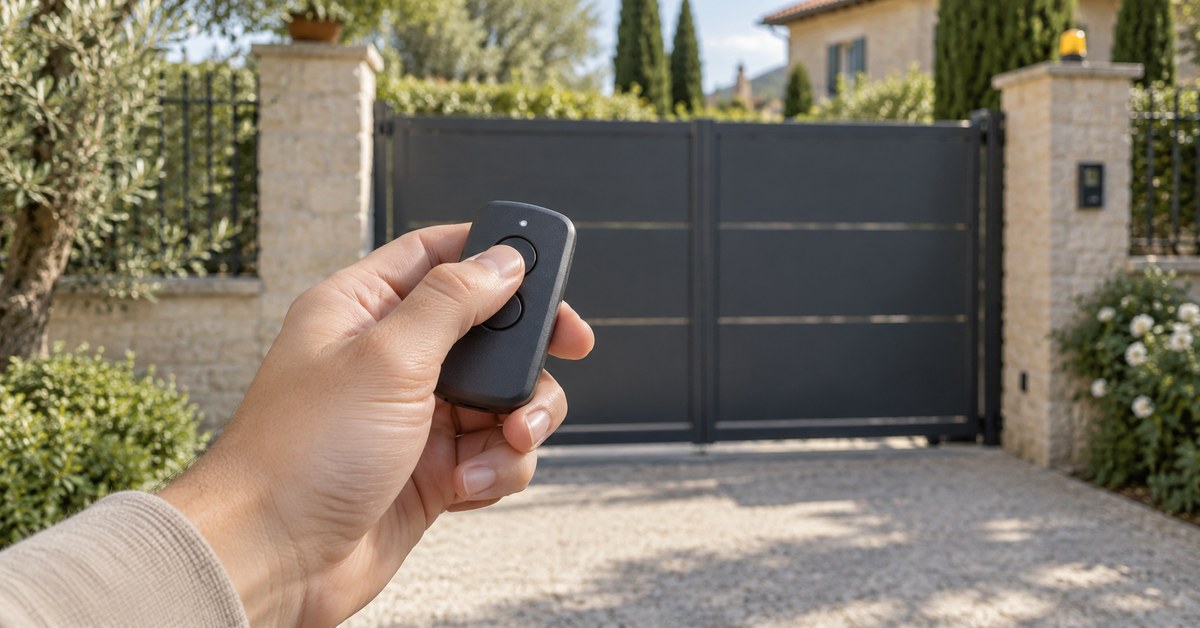
In short. A fixed code remote sends the same code every time; a rolling code remote sends a different code at every press, generated by an algorithm that only the gate's receiver can check. The frequency alone will not tell you which one you have: you need the brand and model. With those two details the compatibility checker tells you whether your remote can be copied onto 1Control WHY.
- Fixed code: often set with DIP switches inside the remote, easier to copy.
- Rolling code: more secure; it can be copied only if its family is supported.
- Crystal remotes below 50 MHz: almost always fixed code, copied with QZERO.
Anyone looking for a spare remote for a gate or garage door soon meets two terms: "fixed code" and "rolling code". Almost everything depends on the difference: how secure the system is, whether a universal remote can copy it, and whether the receiver has to be involved after the copy. Here is how the two systems work, how to tell them apart without taking anything apart, and what can really be copied.
Fixed code: the same code at every press
With a fixed code, each button of the remote sends a sequence that never changes. The gate's receiver compares it with the codes in its memory and, if it matches, drives the motor. The code is set in one of two ways:
- with DIP switches: a row of tiny switches inside the remote, set to the same combination as the receiver. This is how older remotes work;
- at the factory: the code is written into the remote during production and the receiver "learns" it through a pairing procedure.
The advantage is simplicity: a faithful copy of the signal opens exactly like the original. The drawback is the same thing: anyone able to record that signal could replay it. That is why fixed code today survives mainly on older installations and on low-frequency crystal remotes.
What is rolling code technology?
A rolling code remote (also called hopping code or variable code) holds a counter and a secret key. At every press the counter moves on and an algorithm calculates a new code. The receiver knows the key and the counter position, so it knows which codes to expect and accepts only those that come after the last one received, within a tolerance window. A code that has already been used is rejected.
This has three practical consequences:
- Security: recording a transmission is not enough to open, because that code is no longer valid.
- Copying: you are not copying "a sequence", you need to know how that family of remotes works. That is why a universal remote copies only the rolling codes it supports.
- Pairing: each remote often has a serial number that the receiver stores one by one. A new remote, even an identical one, has to be added.
Each manufacturer has its own families: Nice, for example, separates its FLO remotes (fixed code) from FLOR (rolling code), and FAAC calls its variable-code technology SLH. Hörmann BiSecur is a bidirectional, encrypted system and a case of its own.
How to tell whether your remote is rolling code or fixed code
You do not need to open the control board. The remote in your hand and a few minutes are enough:
- Read the label. On the back or inside the battery compartment you will find the brand, the model and often the frequency (433.92 MHz, 868 MHz, 30.875 MHz…). The model is what matters.
- Open the battery compartment. If you see a row of small numbered switches (DIP switches), the remote is almost certainly fixed code.
- Look at the model name. Letters such as "R", "RC", "rolling" or the name of the maker's technology often point to a variable code.
- Check the model in the checker. The WHY and QZERO checker covers more than 800 models and tells you whether yours can be copied, and with which product.
- If in doubt, the manual. The manual of the receiver or the remote explains how remotes are added: if it takes a procedure on the receiver or from a "master" remote, the system is almost always variable code.
Two clues that do not work: the frequency (433.92 MHz carries both fixed and rolling codes) and the colour or blinking of the LED, which usually only shows transmission and battery.
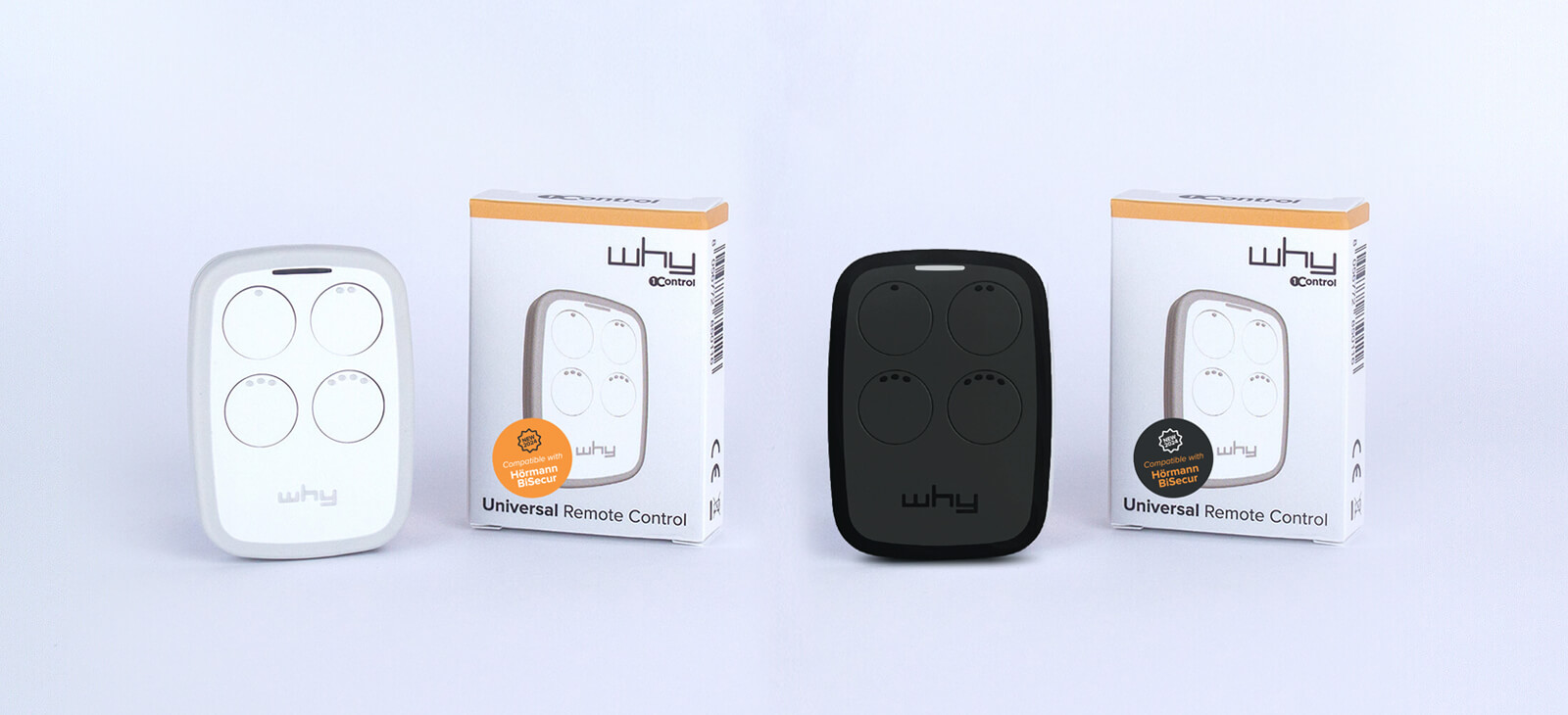
Need to replace or copy your remote?
Check whether your brand is supported: 1Control WHY is the universal remote that replaces your original transmitters, one-off purchase, no subscription.
58,00€ 52,00€ VAT included
- 1,500+ reviews on Amazon, Facebook and Trustpilot
- Secure payments
- 2-year warranty
Frequency and coding are not the same thing
The frequency tells you which radio "channel" carries the signal; the coding tells you how the message is written. Two 433.92 MHz remotes may not understand each other at all: one fixed code and one rolling code, or two rolling codes from different families. That is why "433 MHz compatible" means nothing without the model.
| Frequency | Codings you will find | Copy with 1Control |
|---|---|---|
| 15-50 MHz (crystal: 26, 30, 40 MHz…) | almost always fixed code | QZERO, models in the catalogue |
| from about 300 to 868 MHz (433.92 and 868 MHz most common) | fixed code and rolling code | WHY, models in the catalogue |
If the label does not show the frequency, you will find it in the manual or from the brand and model in the checker. More ways to find it are in the guide on how to choose a universal gate remote.
What can be copied, and with what
Fixed code. The simplest case: WHY reads the signal of the original and repeats it. For crystal remotes between 15 and 50 MHz the right product is QZERO, which copies exactly those frequencies.
Rolling code. WHY also copies many rolling codes: those of the families in the catalogue, not any rolling code. With some receivers, after the copy, WHY also has to be authorised on the control board, using the same procedure as for adding a new remote; it does not delete or change the existing remotes. If your system needs it, 1Control support can help you from a photo of the control board.
Hörmann BiSecur. HS-BS remotes are compatible with WHY; to open from your phone you need SOLO BS.
Two things always hold: the copy does not disable the original, which keeps working, and WHY has four buttons, so it can hold remotes of different brands, codings and frequencies. The copy procedure depends on the model: step-by-step guides are in the WHY manuals. If you would rather have the remote on your phone than in your pocket, read how to copy your garage remote to your phone.
Rolling code and security: what really changes
Rolling code was created to stop a recorded signal from being reused. That is why almost all recent systems use it, and why a universal remote cannot copy "any" rolling code: it has to know the family, and the original remote has to be in your hands.
Fixed code is not "insecure" as such, but it protects less. If your gate still uses DIP-switch remotes and that worries you, talk to your installer: they are the one who can upgrade the receiver. On a shared gate, the decision lies with the building manager.
One common-sense rule applies to both codings: only copy remotes you are entitled to use, and if you lose one, have it removed from the receiver's memory.
Fixed code vs rolling code at a glance
| Fixed code | Rolling code | |
|---|---|---|
| Code sent | always the same | changes at every press |
| How to recognise it | DIP switches, older systems, crystal remotes | maker's technology name, pairing from the receiver or a master remote |
| Security | lower | higher |
| Copy with WHY | yes, if the model is in the catalogue | yes, only for the families in the catalogue |
| After the copy | works straight away | sometimes has to be authorised on the receiver |
If you need the remote for a car park barrier, the guide to the barrier gate remote control explains how to choose brand and frequency.
Frequently asked questions
What is rolling code technology?
It is a coding in which the remote sends a new code at every press, calculated from a counter and a secret key. The receiver accepts only the codes that follow the last one received, so a recorded transmission cannot be reused.
How do I tell if my remote is rolling code?
Read the brand and model on the label and look them up in the 1Control compatibility checker. If there are DIP switches in the battery compartment, it is fixed code. The frequency alone is not enough: both codings exist at 433.92 MHz.
Can a rolling code remote be copied?
Yes, if it belongs to a supported family. 1Control WHY copies more than 800 models, fixed code and rolling code; with some receivers WHY has to be authorised on the control board after the copy. No remote copies every rolling code.
Does my LiftMaster have a rolling code?
Chamberlain and LiftMaster openers sold in recent years generally use rolling code systems. Which one depends on the model: read it on the remote and check it in the compatibility checker before buying a copy.
How do I find the frequency of my remote?
It is often printed on the label or inside the battery compartment, for example 433.92 MHz, 868 MHz or 30.875 MHz. Otherwise it is in the manual, or you can get it from the brand and model in the compatibility checker.
What do I use for a 30 or 40 MHz crystal remote?
Crystal remotes between 15 and 50 MHz cannot be copied with WHY: for those frequencies there is 1Control QZERO. Check the model in the WHY and QZERO checker before buying.
The bottom line
Fixed code and rolling code differ in how the code is generated, not in the frequency. To know which one you have, and whether it can be copied, you need the brand and model of the remote: with those two details the checker tells you in seconds whether to use WHY, QZERO or neither. If you are still choosing a type of remote, start from the universal gate remote guide.