A sliding door cannot use an ordinary latch: a hinged door’s latch pushes against the keep, but a leaf that slides sideways has to be hooked to the frame. In short: most sliding patio doors in Ireland, in uPVC or aluminium, lock with a multipoint mechanism of hooks worked by the handle and a euro cylinder for the key; internal sliding and pocket doors use a small hook lock with a thumbturn, a key or a cylinder. Here is how to recognise yours, what to measure, the most common faults, and what to expect, without promises, from a smart lock such as 1Control DORY.
Which sliding door do you have?
The lock depends first on how the door slides:
- sliding patio door: the large uPVC or aluminium door to the garden. One leaf slides past a fixed pane; the handle drives hooks along the edge and a euro cylinder locks it from outside;
- lift-and-slide door: turning the handle lifts the leaf off its seals before it slides, and turning it back lowers and locks it;
- tilt-and-slide door: the leaf tilts in for ventilation and slides sideways to open;
- internal pocket door: the leaf disappears into a cassette in the wall, with a flush pull and a small hook lock;
- barn-style sliding door: the leaf runs on a visible track in front of the wall, often with no lock at all, or a surface hook or bolt.
How a patio door lock works
Multipoint hook lock
On most patio doors the gearbox in the edge of the sliding leaf drives two or more hooks that catch keeps on the frame, so the leaf cannot slide. The handle works the hooks; the euro cylinder lets you lock and unlock from outside, and from inside you usually lock with a thumbturn or the key.
Anti-lift protection
A sliding leaf sits on rollers in a track, so many doors have anti-lift blocks or pads at the top to stop the leaf being lifted out when locked. If they are missing, the lock alone does not hold the leaf.
Internal pocket and sliding doors
Inside the house the hook lock is much simpler: a thumbturn for passage doors, a bathroom version with an emergency release, a lever key, or a euro cylinder when the room really needs locking. The pull is set flush into the door, because nothing can stick out when it slides into the wall.
What to measure
For a patio door: the cylinder measurements from the fixing screw to each face, the gearbox backset, the forend size and the position of the hooks. For a pocket door: door thickness, backset, forend and pull size. If the door or cassette has a brand, start with the replacement made for that system.

Thinking about a smart lock?
Check whether your door is compatible with 1Control DORY: it replaces your existing euro cylinder with no drilling and no changes to the door, and its mechanical key is always available. One-off purchase, no subscription.
299,00€ from 249,00€ VAT included
- 1,500+ reviews on Amazon, Facebook and Trustpilot
- Secure payments
- 2-year warranty
The patio door euro cylinder
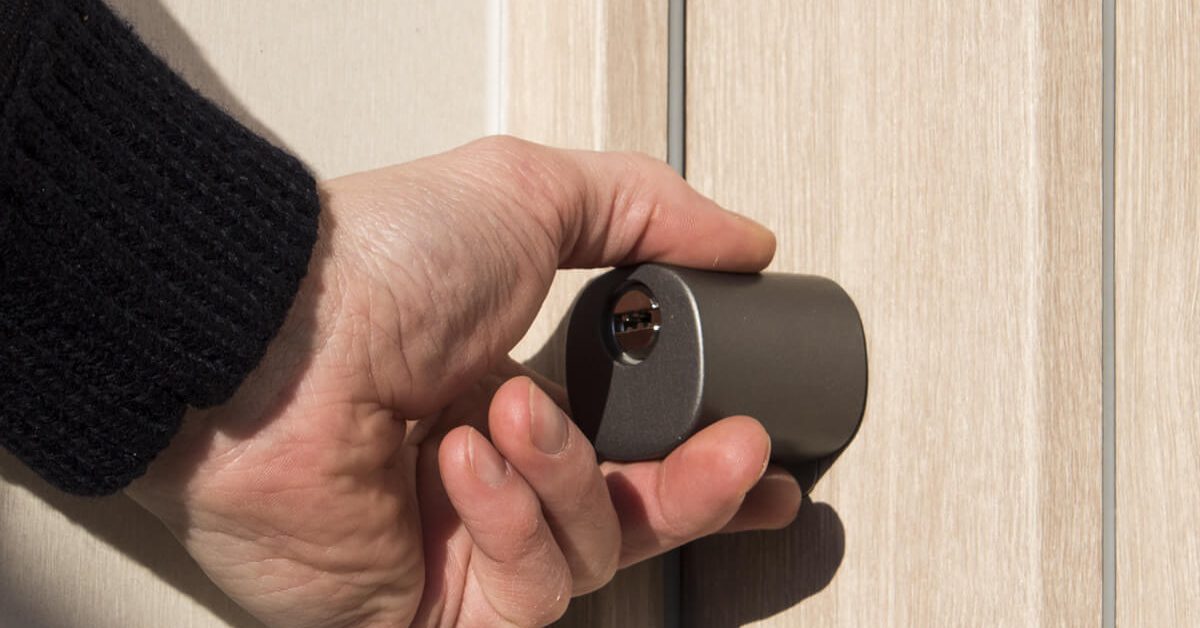
The cylinder on a patio door is a standard euro cylinder: measured from the fixing screw to the inside and to the outside, and removed by undoing the screw on the edge of the leaf and turning the key slightly. Two practical points:
- on narrow aluminium and uPVC profiles the cylinder sits close to the edge of the leaf, and there may be little room for knobs;
- the cylinder only releases the multipoint lock: it is the handle that throws and withdraws the hooks.
If the key turns but the hooks do not move, the problem is the gearbox or the handle, not the cylinder.
Common problems and what to check
- The hooks do not engage: the leaf is not reaching the frame or has dropped. Adjust the rollers (usually through holes at the bottom of the leaf) and the keeps until the hooks line up; sometimes moving a keep a few millimetres is enough.
- The handle turns but the door stays unlocked: worn gearbox, broken hook or loose handle spindle. Check the gearbox before buying a new cylinder.
- The door is hard to slide: dirty track or worn rollers. Clean the track and check the rollers before forcing the handle.
- The leaf lifts or rattles: anti-lift blocks missing or out of place.
- The key is stiff: dust and damp in the cylinder. Use a lubricant meant for cylinders; if it stays stiff, replace the cylinder.
- The pocket door hook will not catch: the leaf has dropped on its hangers or does not reach the frame: adjust the hangers or move the keep.
Smart locks on sliding and patio doors
Honesty first. DORY replaces the euro cylinder and nothing else: it does not slide the leaf and does not motorise the handle or the multipoint lock. So:
- on a sliding or pocket door with a hook lock and no cylinder (thumbturn, lever key, bathroom release) there is nothing to replace: DORY is not the answer;
- on a patio door with a euro cylinder, DORY would take the cylinder’s place, but the handle stays manual: once opening is enabled, you turn the knob and then the handle;
- in that case the usual checks apply: euro cylinder held by the side screw, at least 3 cm between the cylinder and the edge of the leaf, the critical point on narrow profiles, and the measurements of both sides.
Compatibility cannot be promised in advance: every check is in smart lock door compatibility, and the DORY compatibility check answers in four questions.
Frequently asked questions
How does a sliding patio door lock work?
The handle drives hooks along the edge of the sliding leaf that catch keeps on the frame. A euro cylinder lets you lock and unlock from outside.
Why will my patio door not lock?
Usually the leaf has dropped or no longer reaches the frame, so the hooks miss the keeps: adjust the rollers and keeps. If the hooks do not move at all, check the gearbox and handle.
How do I change a patio door euro cylinder?
Open the leaf, undo the fixing screw on its edge, turn the key slightly and slide the cylinder out. The new one needs the same measurements either side of the screw.
How do I lock an internal sliding door?
With a hook lock made for the door or pocket system: a thumbturn, a bathroom version, a key or a euro cylinder throws a hook into the keep on the frame.
Does DORY work on a sliding patio door?
Only if the door has a euro cylinder and passes the checks, starting with 3 cm between cylinder and edge. DORY does not slide the door or motorise the handle; with a hook lock and no cylinder it is not the answer.
Conclusion
On a patio door the lock is a set of hooks worked by the handle, with a standard euro cylinder for the key; on internal sliding doors it is a small hook lock chosen for the system and the use. Most faults come from a leaf that has dropped or a worn gearbox, not the cylinder. If you are considering a smart lock, check the door first with the DORY compatibility check; for hinged internal doors there is the guide to internal door locks.